
Brake Disc RFQ: Full Geometry Before Unit Price
Record disc diameter, nominal thickness, height, centering, hole geometry and construction before comparing individual-disc quotations.
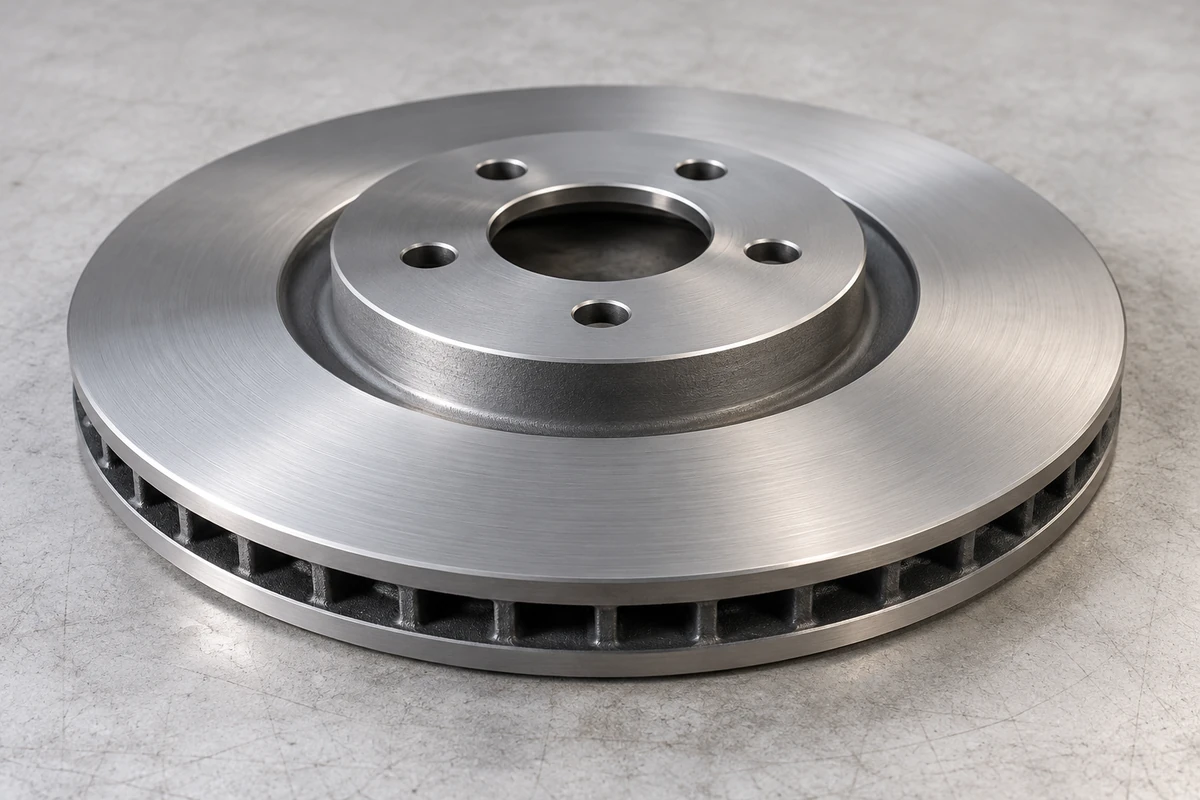
A brake-disc quote that answers only “320 mm” leaves most of the geometry record unresolved. The RFQ should identify the authorized application and the full required geometry, including which field describes the new part’s nominal thickness. A minimum-service field is not an alternative nominal purchase dimension.
Use this comparison to establish what is being quoted, not to approve a disc from its dimensions. Geometry completeness, product-specific validation and commercial price are separate decisions. No diameter match authorizes installation, machining or a braking trial.
Read several catalogue fields together
Brembo’s European catalogue record for 09.F363.11 describes a front ventilated disc with diameter 320 mm, nominal thickness 30 mm, height 57.4 mm, centering 85 mm and five holes, with one unit per box. These are bounded example fields, not a complete drawing or a fit recommendation. The English page could not be reopened during the 13 October 2026 review. These bounded fields rely on the supplied earlier page observation, with official Czech indexed catalogue text used only as secondary corroboration. Recheck the applicable primary record before relying on these fields for an actual order. Brembo 09.F363.11 English catalogue · Official localized catalogue result
The entry also distinguishes a minimum-thickness field from nominal thickness. The purchasing lesson is to retain field meaning, not to give a service limit or maintenance procedure. When a supplier supplies an unlabeled thickness, ask which field it means rather than assuming it answers the new-part requirement.
A five-hole count alone is not a complete hole-pattern record. For an actual RFQ, use the authorized drawing or application-specific source for the required geometry. Do not invent missing hole positions, bolt-circle dimensions or tolerances from the named example.
Establish the geometry source before copying numbers
Record the exact approved application/reference and the authoritative drawing or catalogue evidence used by the responsible reviewer. Preserve its dimension names and units. If one supplier uses a different naming convention, ask it to identify the corresponding feature instead of silently aligning columns by similar numbers.
Separate diameter, nominal thickness, height and centering. A supplier’s answer that matches one field cannot be extended to another. Record the required ventilated or solid construction as its own field; do not treat it as a cosmetic variant or infer it from a product family’s name.
Where the supplier proposes a drawing-based alternative, request explicit differences and the necessary product-specific evidence. A dimensioned proposal is still a proposal. Matching geometry does not demonstrate material condition, braking behavior, durability or legal acceptance for the intended use.
A geometry-first quote worksheet
| Field | Buyer record | Supplier response needed |
|---|---|---|
| Application | Approved exact reference | Actual offered disc identity |
| Diameter | Authorized field and units | Matching offered field or declared difference |
| Nominal thickness | New-part requirement with its source | Value clearly identified as nominal |
| Height and centering | Separate drawing/catalogue callouts | Each feature answered independently |
| Holes | Complete required hole-geometry reference | Evidence beyond a count where required |
| Construction | Authorized ventilated/solid scope | Exact offered construction |
| Commercial unit | One individual disc | Actual pieces represented by the price |
| Technical acceptance | Required evidence and responsible owner | Product-specific documents and unresolved gaps |
Do not add a minimum-service number into the nominal-thickness row. Do not mark an unanswered hole pattern complete simply because the count is present. A purchasing record should reveal these missing distinctions before the price becomes persuasive.
Fictional comparison: diameter-only versus a mislabeled thickness
A fictional buyer has an approved full geometry record for a disc. Offer A confirms only diameter. Offer B answers diameter, height, centering and construction, but labels its thickness with a minimum-service field instead of a nominal new-part field. Neither offer is real, and no numerical substitute is prescribed.
A remains incomplete on the other required geometry. Ask for those fields against the actual offered product. B needs a specific correction: identify the new part’s nominal thickness from the applicable source and keep any service field separate. Do not assume B’s disc is suitable or unsuitable solely because its reply used the wrong label; first establish what it actually proposes.
If B’s clarification reveals a different nominal dimension, treat that as a changed product, not a documentation typo that purchasing can waive. If it confirms the required dimension, the geometry record becomes clearer but the necessary technical acceptance still remains.
The two next questions are different. A needs a fuller record; B needs the meaning of one critical field resolved. Neither should be repaired by a generic “same as OE” statement or an arbitrary allowance in the price comparison.
Keep per-disc pricing ancillary
Ask the supplier to state the actual number of individual discs covered by its quotation, then compare the same unit. This is a short commercial normalization step after scope is established. It is not a reason to repeat regional pack discrepancies, carton-rounding calculations or a mixed-SKU order strategy.
Request actual same-geometry, same-construction pricing and retain any alternative as a separate proposal. A cheaper disc with different fields is not a saving on the baseline until an authorized technical process accepts that alternative. Do not presume that a similar casting, coating or outer diameter preserves required performance.
The finished purchasing record should connect the exact offered disc, the complete geometry response and the unresolved evidence. It can support a responsible decision without pretending that dimensional agreement is a safety or fit certificate.
Prepare the sourcing request
For the broader product group, see Brake parts. If the application is not established, start with the OE and application identification guide before asking for a substitute.
Use the Autoparts sourcing request to describe the required item and the particular question left open above. The form accepts a description of 8–1200 characters and up to five PNG, JPEG, WebP or GIF images, limited to 10 MiB each and 20 MiB total. It does not accept CAD, PDF or ZIP attachments. Authorized drawing images can start a discussion; arrange other technical files separately through an actually agreed, authorized exchange.
Keep requests for independent aftermarket or unbranded alternatives tied to the authorized application or drawing. Supplier negotiation and a drawing-based proposal do not establish engineering acceptance, actual manufacturing capability or guaranteed savings. Named catalogue products in this article are documentary examples, not branded-goods offers or approvals of an unknown alternative.
Frequently asked questions
Is brake disc diameter enough to compare supplier offers?
No. Record the full authorized geometry and construction scope, including nominal thickness, height, centering and the required hole information. Diameter is one field, not a substitute for the rest of the application-specific record or technical acceptance.
Can minimum thickness be used as the nominal new-disc thickness?
No. Preserve the distinction between the catalogue’s service-related field and the new-part nominal requirement. If a quote says only thickness, ask which field it identifies. This RFQ guide does not provide maintenance limits or wear-check instructions.
Does a matching hole count establish the hole pattern?
No. Count alone does not identify all required hole geometry. Use the authorized drawing or application-specific evidence and request the missing detail. Do not infer a bolt circle or other dimensions from a photograph or another product.
Should the price be recorded per box or per disc?
Have the supplier state both the actual package count and the price basis, then use one individual disc for a clear unit comparison. This commercial clarification does not resolve missing geometry, construction or validation evidence.
Sources
Discuss a sourcing request related to this article.Brake Disc RFQ: Full Geometry Before Unit Price