
Thermostat-Housing Repeats: Recheck a Changed Unit
Compare the previous accepted housing assembly with the current offered unit before repeating quantities that no longer cover the same scope.
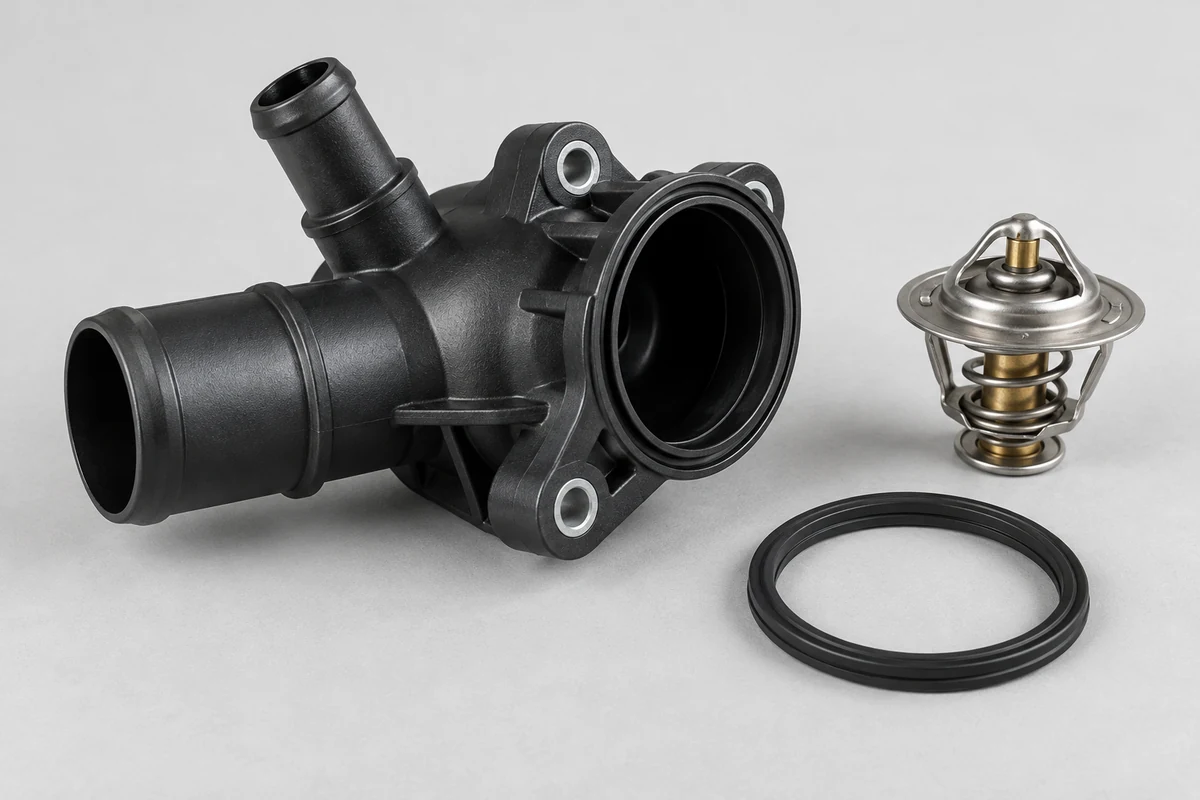
A thermostat-housing repeat can keep the same headline quantity while changing what each purchased unit contains. If an assembly is replaced in the offer by housing-only supply, copying the last order quantity may leave already authorized jobs without the components their purchasing basis assumed.
Reopen the affected buy against the documented change. Do not infer that a supplier changed anything without evidence, and do not use this review to choose thermostat specifications, decide reuse or prescribe cooling-system work.
Record the old and new supplied objects side by side
Dorman's 902-204 page lists a thermostat and gasket in the named assembly. Its package contents mention upper and lower housing bolts while the mounting-hardware field says No. Reopened on 14 October 2026, that wording needs a scoped clarification rather than an invented explanation. Dorman 902-204 contents
The example shows why a housing title alone cannot preserve the purchased unit. For the actual repeat, retain the previous accepted order definition, including any one-time exception. Compare it with the current attributable supplier response. A familiar SKU in a message does not override an explicit changed contents statement.
Use separate fields for housing scope, included thermostat, gasket and any relevant hardware question already established by the job owner. Do not copy the named example's temperature, outlet count or components into another application's requirement.
Translate the change into coverage consequences
Start with the same remaining authorized jobs used by the repeat proposal. Apply eligible old-format stock only where its existing approval and allocation permit. Keep new-format supply separate until its actual scope and acceptance are established.
A housing-only unit may cover only the housing portion of a previously assembly-based obligation. Purchasing must not invent the missing thermostat or gasket supply, assume retained components are usable, or add arbitrary prices to make the new offer look equivalent.
Ask whether the supplier can still offer the accepted full unit. If it instead proposes separate components, request an itemized actual offer and the responsible owner's decision on that revised purchasing scope. Equal total piece count or a lower housing price does not settle the result.
A repeat-unit change worksheet
| Field | Evidence to compare |
|---|---|
| Previous accepted unit | Exact prior assembly scope and accepted exceptions |
| Current offered unit | Actual new response, SKU and declared changes |
| Included thermostat | Included, excluded or unresolved for each offer |
| Included gasket | Exact confirmed scope, not a generic photograph |
| Confirmed change | Attributable difference and responsible decision owner |
| Revised shortage | Jobs or required supply left uncovered by the new basis |
Preserve unknowns instead of rewriting them as exclusions. Where the hardware fields conflict, record both and obtain the provider's itemized explanation. A change worksheet should not manufacture certainty that the original evidence lacks.
Fictional example: six repeat units no longer mean six assemblies
Assume a fictional approved plan needs six complete H-A assemblies, each with an established thermostat and gasket scope. Two eligible old-format H-A units are already available for these jobs. The remaining buy was therefore four complete assemblies.
The current fictional offer explicitly changes to housing-only H-B. Four H-B units do not, by themselves, cover the four complete-assembly obligations. The buyer asks for the original full scope or a separately documented revised proposal. These invented references do not describe an actual change to Dorman's product.
If the provider confirms that the housing-only wording was a clerical error and supplies an attributable corrected full-unit offer, retain the correction and review that actual offer. Do not keep treating the old error as a real product change. Conversely, if the exclusion is confirmed, do not reuse the previous complete-assembly approval automatically.
Suppose the responsible owner later approves a defined separate-component route for the remaining four jobs. In this fictional decision only, each job needs one H-B housing, one T-B thermostat and one G-B gasket. Three eligible T-B units and one eligible G-B unit are expressly approved and available for these four jobs, with no H-B stock. The purchasing gaps are then four H-B, one T-B and three G-B. These invented quantities define no real repair or bill of materials.
The two complete old-format H-A assemblies remain allocated to the first two jobs as whole units. Do not count their included thermostats and gaskets again against the four changed-route jobs. The six original obligations reconcile as two covered by complete H-A and four covered only when every item in the approved revised route is accounted for. If G-B eligibility is unresolved, that route's coverage remains conditional even after all four housings are quoted.
Close the repeat with a precise unit description
The final purchasing instruction should identify the accepted supplied object and quantity, carry any approved change limits and list unresolved supply conditions. Keep previous receipts unchanged as historical evidence. A new acceptance applies only to its documented scope and does not retroactively redefine old stock.
This check is narrower than a general continuity declaration: it follows the consequences of a changed housing/thermostat/gasket supply boundary into an actual replenishment quantity. It establishes no fit guarantee, changed temperature requirement or approval to assemble alternatives.
Request the identified replenishment
See Cooling parts for category context. In an Autoparts sourcing request, identify the approved product and the unresolved replenishment question. The form accepts an 8–1200-character description or supported marketplace link, and up to five PNG, JPEG, WebP or GIF images, limited to 10 MiB each and 20 MiB total. Other technical files need a separately agreed, authorized exchange; the image field is not a PDF, CAD or ZIP portal.
Named manufacturer products are documentary examples, not branded supply offers, affiliation or evidence that another supplier can make or validate an alternative. Independent buying coordination and supplier negotiation do not establish fit, safety approval or guaranteed savings.
Frequently asked questions
Does repeating the same housing quantity preserve job coverage?
Only if the accepted supplied unit and relevant scope remain applicable. A housing-only offer can contain fewer required components than a previous assembly. Compare the documented definitions and show the resulting uncovered supply before copying the quantity.
Should a vague new description be treated as a confirmed change?
No. Preserve the discrepancy and ask for an attributable clarification. It may be a clerical error, a real exclusion or an unresolved offer. Do not invent supplier changes or silently carry forward the old contents assumption.
Can purchasing add a thermostat and gasket to make the new offer complete?
Only through an actual separately scoped offer and the responsible owner’s acceptance of the revised arrangement. Do not invent component prices, assume reuse or choose a thermostat specification to make the arithmetic match the old assembly.
How should old complete assemblies be recorded after the change?
Retain their original identities, eligibility and allocations. A new offer does not retroactively change their contents or approval. Apply them only to supported obligations, and keep the changed-format stock and purchasing decision separate.
Sources
Discuss a sourcing request related to this article.Thermostat-Housing Repeats: Recheck a Changed Unit