
Compressor Handover: Residual-Oil Work Scope
Keep a replacement compressor’s supplied-fill declaration separate from the existing circuit history, residual-oil question and agreed qualified work scope.
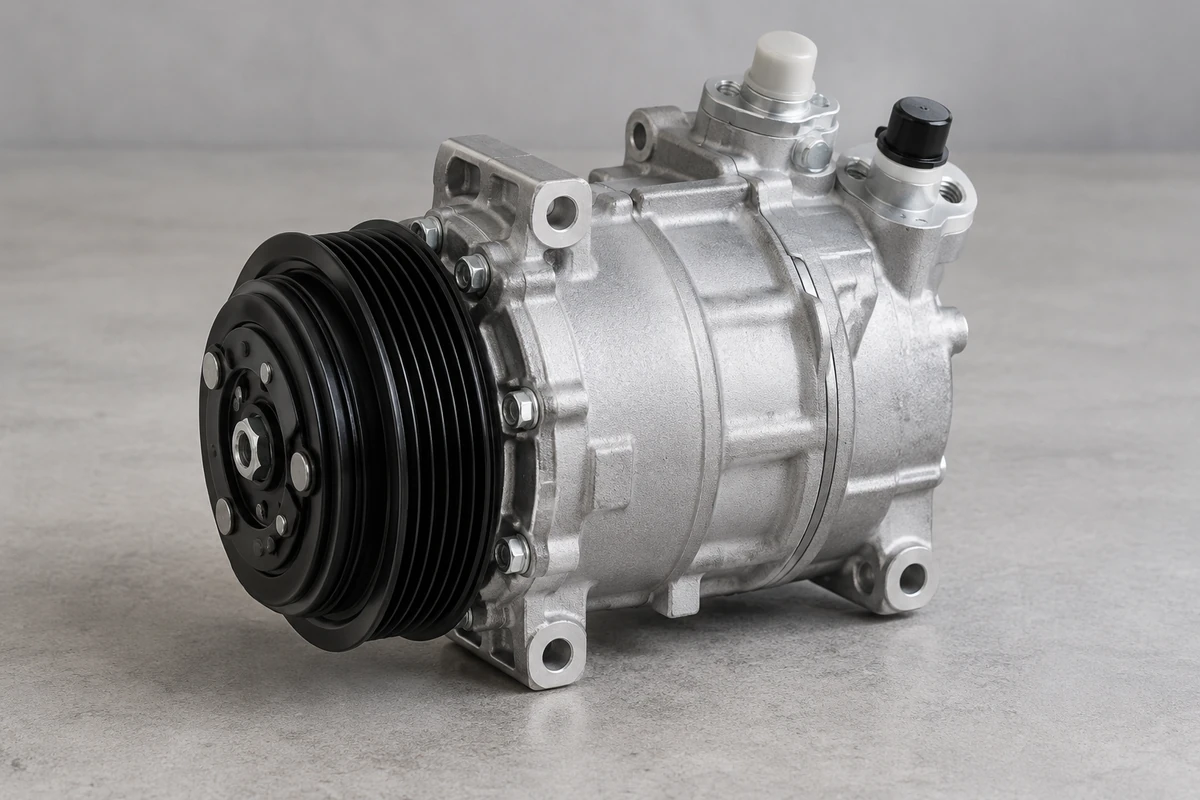
A complete compressor fill declaration can close a receiving-document question while leaving the existing A/C circuit unresolved. Before handing the replacement to a service provider, identify who owns the residual-system oil question and which current instruction that person will use. Do not describe the compressor as ready for service merely because its supplied fill is documented.
This handover starts after the delivered compressor and its fill declaration have been reconciled. Its subject is the relationship between that supplied state and the service job. It gives no oil calculation, draining, flushing, refrigerant-handling or electrical procedure.
Keep the DENSO example within its range
DENSO's European product FAQ describes its aftermarket compressor prefill on an entire-system basis and identifies a separate residual-oil concern for its 5SE/SL designs without a drain plug. The page was checked on 14 October 2026. These statements concern DENSO's range and are not instructions for an unknown compressor. DENSO compressor FAQ
The documentary lesson is that supplied fill and existing circuit condition are different inputs. A declaration for a new product cannot describe the history of the vehicle to which it may be fitted. The qualified service provider must establish the current requirements for the exact replacement and system.
Carry forward what is actually known about the circuit
Ask the service-record owner for the existing job history relevant to the replacement: the stated reason for the work, previous component changes and any attributable findings already made. Keep the record reference and its scope. Do not turn a buyer's recollection into a technician's finding or label an undocumented circuit clean.
Where the history is unavailable, say which information is missing and who is expected to address it. Unknown history is not a numerical oil deficit. It should not be converted into a guessed adjustment or a standard added service selected by purchasing.
Keep a report of contamination or a previous intervention distinguishable from a simple absence of records. They can lead the qualified provider to different questions. A general note saying old system checked is not useful unless the provider states what that check covered and where its conclusion is recorded.
Ask for a scope answer rather than a quantity answer
Send the exact compressor reference, established supplied-fill declaration and available circuit history to the proposed service owner. Ask which applicable instruction governs the unresolved oil-related dependency and whether the quoted work addresses it. A reply that repeats the compressor's supply declaration has not answered the circuit question.
If the provider identifies additional work, obtain its actual scope and commercial proposal before treating it as included. The buyer should neither demand an invented standard procedure nor presume that a parts price includes all system work. Keep any changed commercial authorization separate from technical acceptance.
Residual-system responsibility worksheet
| Record | Evidence to retain | Decision it supports |
|---|---|---|
| Compressor identity | Exact replacement and application record | Which product instruction is relevant? |
| Supplied fill | Already reconciled declaration and quantity basis | What is the provider receiving? |
| Circuit history | Existing service records with issuer and date | What is known and what remains unknown? |
| Governing instruction | Current exact-product/system reference | Who has established applicability? |
| Qualified work scope | Named provider’s accepted scope | Is the residual-system question covered? |
| Exception disposition | Attributable answer and remaining restriction | Can this documentary dependency close? |
The worksheet requests evidence ownership. It does not specify how to inspect the circuit or decide a service amount. Retain the supplied declaration unchanged while the service provider assesses the separate question.
Fictional case: the replacement is documented, the circuit is not
Fictional compressor C arrives with an attributable fill sheet matching the order. A buyer then forwards C to Workshop A with the message complete unit supplied. The prior workshop's record mentions an earlier intervention but contains no attributable circuit-condition conclusion. No actual compressor, amount or repair is represented.
Workshop A responds with the same fill sheet and confirms receipt. That advances custody of the replacement, not the residual-system question. The buyer asks A to identify its proposed responsibility for the unresolved history and the applicable instruction, while requesting the missing earlier record from its owner.
Suppose A returns a scoped proposal contingent on reviewing that history. The buyer can consider the commercial proposal without declaring the technical dependency resolved. If the history later proves unavailable, A must state the effect on its assessment; the buyer cannot substitute a calculation based on the compressor label.
Close the service-information gap explicitly
The completed handover identifies what the provider received, what it knows about the circuit and which unresolved conditions it accepted responsibility to assess. A corrected fill document does not erase earlier system uncertainty. A negotiated price does not establish that the qualified work has been completed. Keep those conclusions with the actual service records and responsible reviewer.
Keep the purchasing enquiry focused
For category context, see Cooling parts. In an Autoparts sourcing request, identify the actual part and the unresolved handover question. The form supports an 8–1200-character description or a supported marketplace HTTPS link, and up to five PNG, JPEG, WebP or GIF images, limited to 10 MiB each and 20 MiB combined. PDF, CAD and ZIP files need a separately agreed, authorized exchange.
Independent aftermarket or unbranded buying coordination and supplier negotiation do not establish service-provider capability, fitment, engineering approval or a ready-for-use vehicle. Named manufacturers above are documentary examples, with no affiliation or branded-goods offer implied.
Frequently asked questions
Does a system-basis prefill declaration settle residual oil in the vehicle?
It describes the declared supplied fill, not the condition or history of the existing circuit. The qualified provider still needs the actual application information and current instruction to address the system-dependent question.
Should the buyer calculate an adjustment from the fill label?
No calculation is supplied by this handover method. Preserve the label’s stated basis and refer the exact compressor and circuit history to the qualified service owner. Do not turn missing history into a guessed quantity or physical intervention.
What if the receiving workshop repeats only the supplier’s oil sheet?
Ask it to distinguish acknowledgement of the supplied state from its responsibility for the existing-system question. Request the applicable instruction and accepted scope or an explicit statement that the dependency remains outside its proposal.
Can an unknown compressor inherit DENSO’s 5SE/SL guidance?
No. The manufacturer example is limited to its named range and designs. An alternative needs its own current product and system evidence. The article neither prescribes flushing nor establishes that another compressor uses the same service requirements.
Sources
Discuss a sourcing request related to this article.Compressor Handover: Residual-Oil Work Scope