
Keep TPMS service packs intact within assortments
Preserve reference-specific stem and seat inclusions in a TPMS service-pack assortment, so a uniform presentation does not create false shortages or remove required hardware.
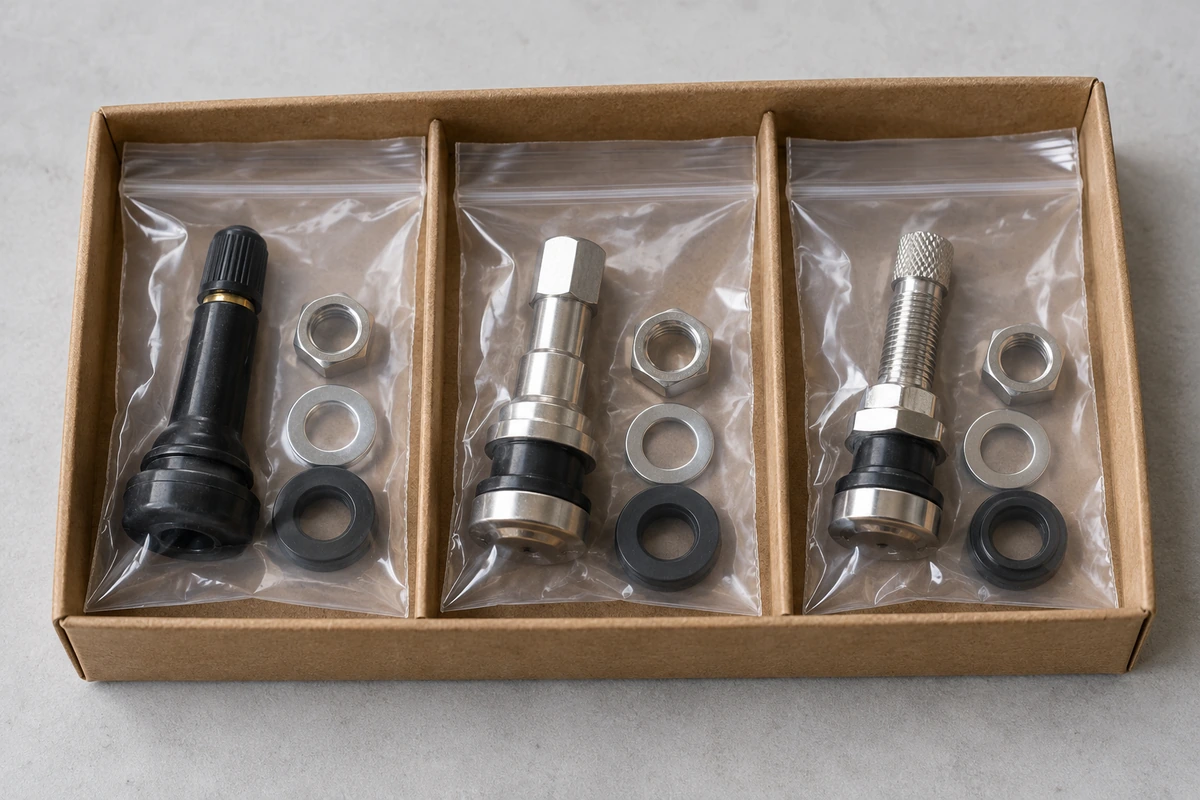
A TPMS service-pack assortment should not make every approved reference look complete by giving it the same hardware. One reference may include a valve stem, while another legitimately excludes it; a seat can also depend on the exact assembly. Before approving a common presentation, ask whether the packer is preserving those reference-specific differences or silently removing them.
The buyer’s decision starts with approved service-pack references and their accepted contents. It concerns which stated inclusions and exclusions survive consolidation. It does not choose a valve for a wheel, establish sensor compatibility or provide a tyre-service procedure.
Read optional components against the exact reference
Schrader’s TPMS service-kit page, checked on 14 October 2026, distinguishes rubber snap-in and clamp-in families. Its rubber snap-in list includes a valve stem; specified clamp-in lists make stem and seat inclusion dependent on the assembly. Its assortment section groups named service-pack references. These are descriptions on the maker’s English page, not a universal contents list or confirmation of every regional offering.
The practical question is whether a conditional statement applies to this particular pack. A catalogue phrase saying a stem is present in some assemblies cannot classify an unexplained absence in an approved snap-in pack. Conversely, a photograph of a stem-containing pack cannot make a stem mandatory in every clamp-in reference.
Retain the provider’s exact contents definition for each purchased reference. Do not combine the longest lists from several families into one standard pack. That would create new requirements and could hide the reason that the original references differ.
Record exclusions as carefully as inclusions
For each component being questioned, use one of three evidence states: included in this approved reference, expressly excluded from it, or not yet established. Absence in a photograph belongs in none of these categories by itself. It is an observation requiring the relevant contents answer.
An express exclusion is useful information. Preserve it in the consolidated assortment record where otherwise a recipient might report a false shortage. An unknown inclusion is different: it needs a provider response and should not be converted into an exclusion merely because the pack is already closed.
Keep the physical supplied configuration attributable to its approved reference. A family name can orient the buyer but cannot replace the exact reference when two assemblies within that family have different stem or seat scope. Avoid an assortment-wide tick box reading stems included without stating which packs it covers.
Challenge a proposal to standardize the hardware
Ask what a common-packet or common-tray proposal would change. It may retain each complete identified pack while arranging them uniformly in an outer case. It may instead remove a supplied stem to match neighboring packs, or add a seat because another reference includes one. Only the first description preserves contents without a new product decision.
If the provider proposes a changed service-pack scope, keep it as a separately identified proposal. The packing team cannot establish that the revised hardware is compatible or that a missing item can be supplied from another reference. Do not authorize swaps on the basis of similar color, shape or total piece count.
A complete service pack remains the issue unit within the assortment. Its completeness is judged against its own approved contents, not against the component count of the neighboring pack. Record pack quantities by reference, with loose component totals subordinate to those definitions. A correct overall count cannot reconcile different inclusion rules.
Fictional example: two complete packs legitimately look different
Imagine a fictional assortment containing approved snap-in pack S-A and clamp-in pack C-B. S-A’s accepted schedule includes its specified stem. C-B’s accepted schedule expressly excludes a stem and seat. These references and contents are invented for the example; they do not identify Schrader SKUs or establish any vehicle application.
A proposed common assortment card marks every location as stem and seat included. The packer then reports C-B as short and suggests transferring a stem from S-A. That would both contradict C-B’s confirmed exclusion and remove an included item from S-A. The two approved packs were different before the proposed correction.
The buyer asks the provider to preserve the reference-specific contents statements in the assortment record. C-B should not be treated as short on the basis of the generic card. S-A still needs its approved stem, and nothing in C-B’s family description authorizes taking it. The outcome is a corrected record of the actual approved packs, not advice to assemble or modify a valve.
Now consider a second C-B-looking packet whose exact reference is unreadable and whose contents history is unknown. The confirmed C-B exclusion cannot be transferred to that unidentified packet. Ask the provider to establish the reference and contents basis. It remains unresolved even if it looks just like the documented pack.
Finally, suppose the provider’s actual S-A proposal omits the agreed stem and cites the general statement that some assemblies exclude stems. The buyer has a specific unanswered supply discrepancy. The source’s conditional wording cannot replace the approved S-A contents record.
Close reference-specific completeness before issue
Use a record containing the exact service-pack reference, family, applicable contents source, queried stem or seat, inclusion/exclusion status and final identifiable issue unit. Add the provider responsible for any unknown reference or proposed contents change. This original editorial aid is not a manufacturer acceptance standard.
The accepted assortment should preserve complete packs on their respective approved bases. Keep sensors and other separately purchased products outside those counts unless the actual order expressly includes them in a named pack. Clear accounting does not establish technical interchangeability, and this article supplies no torque, assembly, programming, relearn or pressure-test guidance.
Bring the actual proposal into the sourcing request
See Suspension and steering for category context and the supplier-check guide for the earlier supplier review. The manufacturer example above does not establish affiliation, a branded-goods offer or another supplier’s capability. Independent aftermarket or unbranded proposals need their own attributable evidence.
An Autoparts sourcing request can identify the approved product and the specific packing change still awaiting an answer. The form accepts an 8–1200-character description and up to five PNG, JPEG, WebP or GIF images, at most 10 MiB each and 20 MiB total. It does not accept PDF, CAD or ZIP files; arrange other technical files through a separately agreed, authorized exchange. Buying coordination and supplier negotiation do not establish an owned factory or laboratory, specialist packing services or engineering approval.
Frequently asked questions
Is every TPMS service pack incomplete without a valve stem?
No. The actual approved reference determines whether a stem is included. The manufacturer example includes a stem in its rubber snap-in description and makes inclusion conditional in specified clamp-in descriptions. Confirm which rule applies to the purchased pack; do not classify absence using another pack’s photograph.
Can a general “in some assemblies” note explain a missing stem?
It identifies a conditional range-level fact, not the answer for this reference. If the accepted contents include the stem, the provider still needs to account for it or propose an authorized scope change. If inclusion was never established, keep that question open rather than treating the note as an exclusion.
Can hardware be moved between packs to make every assortment location look alike?
A common appearance does not authorize a changed component allocation. Such a move could remove an included item from one pack while adding an unapproved item to another. Preserve each reference’s accepted contents or obtain a separately supported product-scope decision; the packer should not infer interchangeability.
How should the complete service-pack quantity be counted?
Count complete packs of each approved reference, judging each against its own contents definition. Different references can legitimately have different component counts. Keep the outer assortment and any loose component totals separate, and leave unidentified packets unresolved instead of assigning them the nearest-looking reference’s exclusions.
Sources
Discuss a sourcing request related to this article.Keep TPMS service packs intact within assortments