
CV Boot Kits: Keep Small-Parts Packets Tied to Their Approved Family
Preserve CV boot kit packet identities during consolidation and require evidence before a shared hardware pack replaces joint-specific or universal-kit allocations.
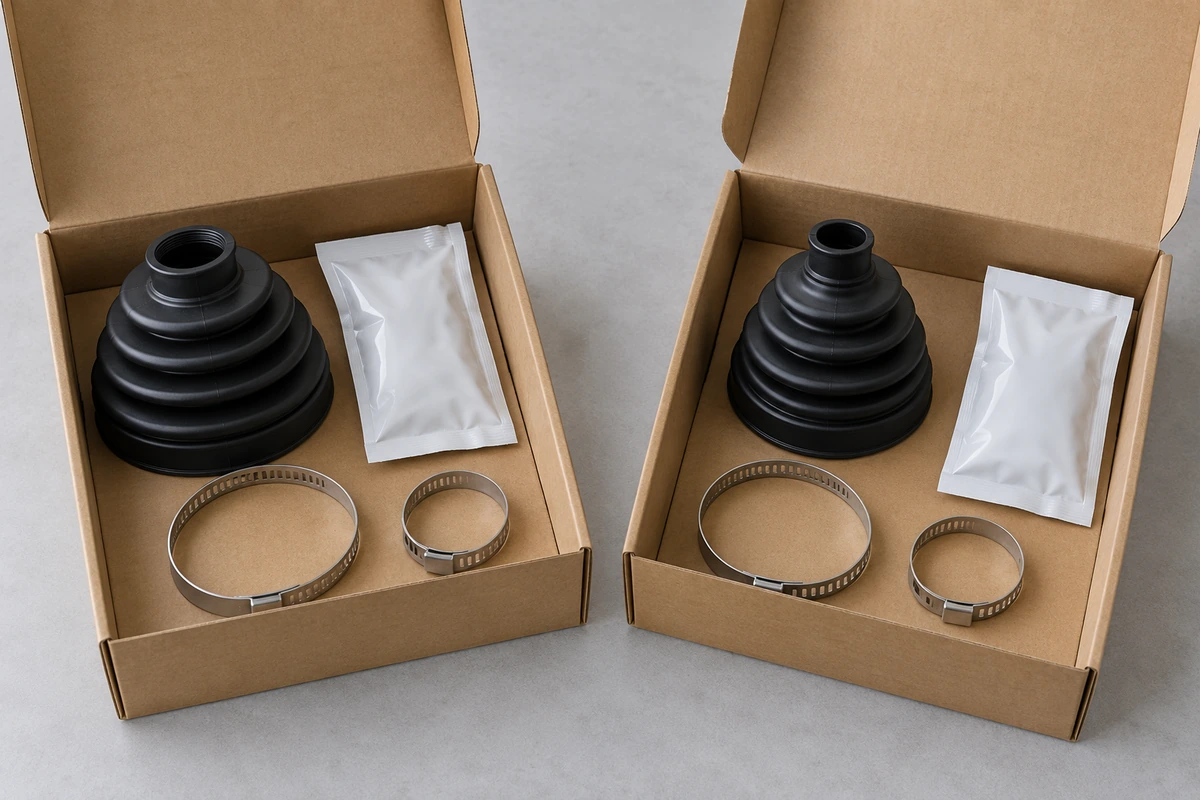
A mixed shipment of approved CV boot kits can lose an important distinction when a consolidator standardizes the small-parts packs. The boots may retain their kit labels while circlips, straps, fasteners or spacers become one common supply. Before approving that change, ask whether the provider has established the same accessory identities for every affected kit reference.
A family description such as universal boot does not, by itself, authorize universal allocation of the accompanying hardware. The packing decision must preserve the actual kit’s approved packet relationship or identify a separately supported change. It cannot establish component interchangeability from a boot’s appearance.
Keep family descriptions subordinate to exact kit references
GKN’s English driveshaft-boots page, checked on 14 October 2026, distinguishes joint-specific and universal product groups and names several possible small-part categories in its kit range. The page supports asking about the complete kit relationship, but does not provide an exact bill of materials for every SKU. GKN driveshaft boot range
Use the purchased kit reference as the parent of the accessory packet. Record the approved family description alongside it, including the provider’s exact terminology where relevant. Avoid collapsing all entries into rubber boot or universal boot just because those labels make a shorter packing list.
The source’s broad range description cannot fill a missing packet schedule. Ask the actual provider what the accepted kit includes. Do not infer grease identity or quantity, a strap specification or a spacer requirement from another kit. Those are product decisions outside a warehouse’s consolidation discretion.
A common packet is an equivalence proposal
Suppose a packer proposes one standard accessory bag for several kit references. That request may be convenient operationally, but it embeds a claim: the specified bag answers each kit’s approved small-parts requirement. Ask for an attributable provider record identifying the actual component references and the kit references it covers.
The record may confirm that some references genuinely share a packet. If so, the buyer can review that established commonality without claiming every kit in the family does. A single confirmed shared strap group would not necessarily establish equivalence of the circlips or spacers traveling beside it.
If the provider cannot establish the relationship, retain the original accepted packet allocation in the proposed scope and ask for an alternative consolidation plan. Do not have the packing team choose a common bag by visual similarity, packet weight or the number of pieces. Those observations do not supply an authorized component-equivalence decision.
Distinguish retained provenance from new sorting
An identified supplier packet already linked to an approved kit provides a different documentary starting point from loose parts recovered after several packets were mixed. A new administrative label can describe where the loose parts are now, but it cannot recreate their previous membership without supporting records.
Ask the provider what evidence survives if a mix has already happened. It may have attributable component-level records or another authorized resolution; its availability must be confirmed. Preserve the uncertainty until the provider answers. Do not label the remaining packet as belonging to the last unfilled kit simply because the arithmetic leaves one of each.
This is also why a counter’s tally and a kit-completion record should remain distinct. One can establish a quantity under the agreed counting scope. The other needs identities and their accepted relationships. Neither creates a technical approval of the underlying parts.
Use a packet-to-family decision record
The following worksheet is an editorial aid for reviewing the proposed change. It does not select CV components or instruct cutting, stretching, fitting or assembly.
| Field | Entry to preserve or obtain |
|---|---|
| Approved kit | Exact kit reference, contents issue and provider |
| Boot family | Accepted description without expanding its meaning |
| Existing accessory packet | Supplied packet reference and link to this kit |
| Proposed common packet | Actual component identities and all affected kit references |
| Shared-content evidence | Provider-confirmed scope, including any groups that remain different |
| Mixed or unallocated parts | Surviving evidence, unresolved identity and responsible decision owner |
Do not require invented manufacturer serial numbers. A real provider packet reference may be sufficient for the agreed association record; where no identifier exists, ask the provider how it establishes the relationship. Buyer shorthand should be clearly administrative and traceable to that answer.
Fictional example: a universal boot label does not answer the strap question
Imagine fictional kits J-1 and U-1, already approved for their respective applications. J-1 is recorded as a joint-specific kit, and U-1 as a universal-family kit. Each has its own accepted accessory packet. The fictional order supplies no evidence that the packets share their component identities.
A consolidator proposes removing both packet descriptions and issuing one standard bag with each boot. The proposed bag has the same piece count as the original packets. That does not resolve whether its straps, circlips and any other included groups are the agreed items for both kits.
The buyer asks the provider to identify the exact scope of any commonality. Suppose the response confirms that one named group is shared but another group remains kit-specific. The common group can be recorded on that bounded basis; the distinct group must keep its own allocation. The response should not be shortened to hardware interchangeable, which would erase the limit that made it useful.
Now suppose the packets have already been emptied into a common bin without an attributable component record. A picture of two similar straps cannot reconstruct the original kit allocation. The buyer records the affected supply as unresolved and asks the provider for its authorized resolution. No component is declared suitable, defective or recoverable solely from this fictional scenario.
Approve only the relationship the provider actually established
The final packing record should retain each approved kit, the accessory packet or confirmed common group assigned to it, and any unallocated items. A later change from a joint-specific kit to a universal alternative is a new product proposal, even if the carton and piece count stay the same.
The practical endpoint is a reviewable packet association. It supplies no assurance of joint fit, material performance or repair completeness. The manufacturer example also establishes no affiliation or ability of another supplier to make, validate or reconstitute a kit.
See Engine parts and how we check an auto-parts supplier for broader buying context. Use the Autoparts sourcing request to name the approved kits and proposed common-packet change. The form accepts 8–1200 characters and up to five PNG, JPEG, WebP or GIF images, limited to 10 MiB each and 20 MiB total. PDF, CAD and ZIP files need a separately agreed, authorized exchange.
Frequently asked questions
Can universal CV boots all use one standard small-parts packet?
That requires evidence for the exact kit and component references. The family label does not establish hardware interchangeability. Ask the responsible provider to identify which groups genuinely share an approved reference and which remain kit-specific before the packing proposal is changed.
What if the accessory packets look identical and contain the same number of pieces?
Appearance and count do not settle component identity or approved allocation. Retain the existing packet-to-kit relationship unless the provider supplies evidence covering the proposed common packet. Any confirmed commonality should be recorded by its actual scope rather than generalized to every accessory.
Can mixed small parts be relabeled using the remaining kit quantities?
Quantity arithmetic alone cannot reconstruct lost membership. Record which identities and allocation evidence remain available, then request a provider disposition. A new buyer label can track the unresolved group, but must not be presented as manufacturer evidence or proof that it belongs to the last unfilled kit.
Does the GKN source establish the grease supplied with each kit?
The article uses the source only for range distinctions and examples of small-part categories. It does not infer any kit’s grease type, amount or inclusion. Those details, where part of the approved order, need an exact provider record and remain outside an ordinary packing team’s discretion.
Sources
Discuss a sourcing request related to this article.CV Boot Kits: Keep Small-Parts Packets Tied to Their Approved Family