
Head-Bolt Reorders: Count Complete Approved Job Sets
Measure head-bolt coverage in complete approved new sets, keeping loose, returned and unverified pieces outside assumed job coverage.
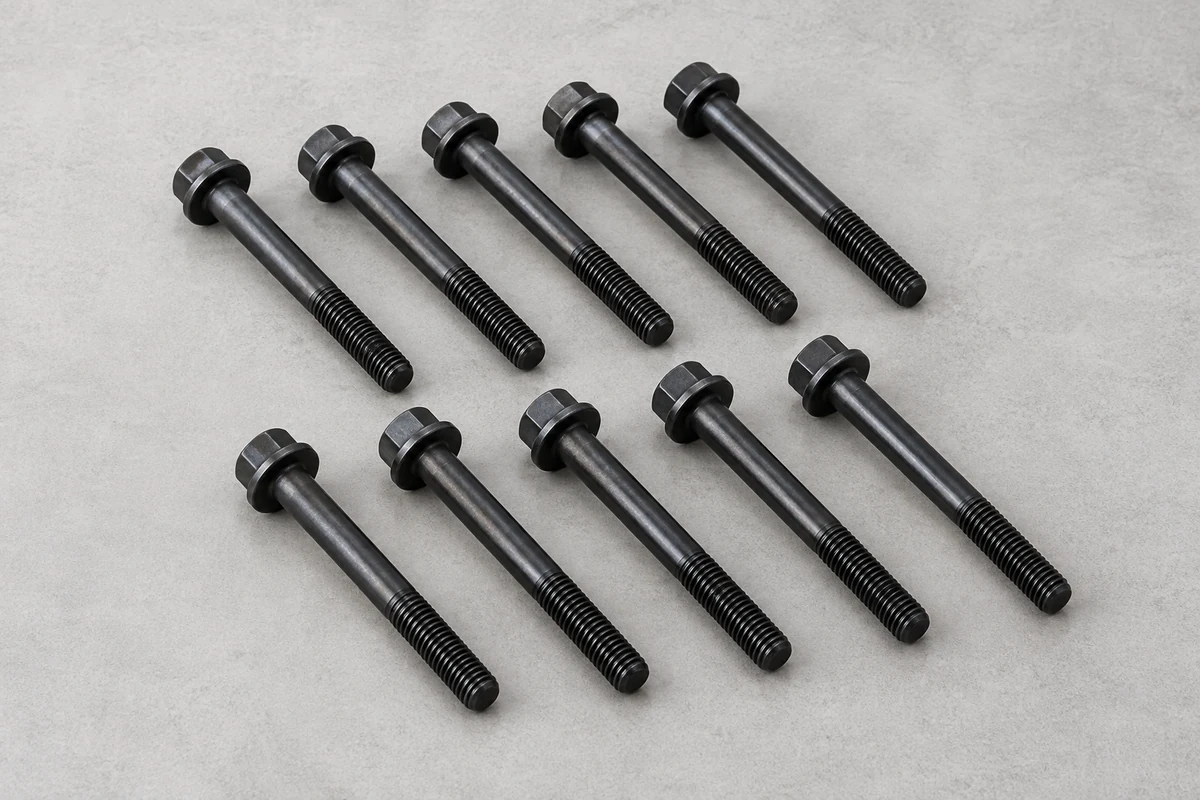
A head-bolt bin can contain more pieces than an upcoming repair seems to need while holding no documented complete set for that engine job. Replenishment should count the approved supplied unit and its established completeness, rather than divide a mixed piece total by an assumed bolts-per-engine number.
Start from the responsible technical owner's authorized job scope. This article follows a requirement for new sets where that is the approved basis; it does not decide whether an existing bolt may be reused, prescribe inspection or supply tightening instructions.
Keep the manufacturer's recommendation within its scope
Elring's cylinder-head-bolt page discusses engine-specific repair supply and recommends new bolts, while acknowledging that some manufacturers permit reuse under their own conditions. Reopened on 14 October 2026, that statement is not a universal legal prohibition or a reuse decision for any particular engine. Elring cylinder-head bolts
For procurement, retain the exact set reference accepted for each job. A general engine family name may group several references in a report but should not collapse them into one coverage pool. The required quantity per complete set must come from the actual product and approved job record, not a photograph or a remembered repair.
A new unopened-looking package still needs an attributable identity. Conversely, opening a package for authorized stock administration does not automatically make its documented contents unusable. Import the responsible condition and completeness decision; do not invent it from packaging appearance.
Separate set coverage from loose-piece inventory
Record complete accepted sets, incomplete identified sets, loose pieces and returned items separately. The last three groups may warrant investigation, but their numerical sum is not automatically a complete new set. Do not ask stores to combine similar-looking bolts simply to reduce the purchase requirement.
If a provider confirms an exact missing component and a separately approved completion route, record that route as its own proposal. The new-set requirement has not been met merely because the missing quantity can be expressed as a number. Whether completion is technically and commercially acceptable remains a responsible decision.
Keep reservations linked to their actual jobs. A set reserved for a job included in this review covers that job once. A set reserved for another obligation must not also cover the next unassigned job. State whether imported stock figures already exclude reservations before deducting them again.
A complete-job-set worksheet
| Field | What the buyer needs |
|---|---|
| Engine job | Unique authorized work scope and required date |
| Approved set reference | Exact accepted identity and supplied-unit definition |
| Complete new sets | Eligible, attributable sets available to those jobs |
| Loose or returned items | Separate populations and unresolved status |
| Uncovered jobs | Jobs without a complete supported set allocation |
| Purchase proposal | Actual set offer, quantity and unanswered conditions |
The key output is uncovered jobs by set reference. Piece totals remain subordinate evidence. Do not introduce a default spare percentage or assume every engine job requires the same set composition.
Fictional example: enough pieces on paper, one set short
Assume three fictional jobs each require one complete approved new set H-A. Stores has two complete eligible H-A sets, plus an incomplete identified group and several returned bolts. The technical owner has supplied no approval for either loose population to satisfy the new-set requirement. All references and conditions are invented.
Two jobs are covered and one remains uncovered. It is incorrect to count all the loose pieces, divide by a presumed set count and declare three jobs covered. The proposed buy is one confirmed H-A set, subject to the actual current offer and purchasing authority.
If the third job is instead approved for H-B, the shortage is H-B, not another H-A. The two complete H-A sets remain useful for their original jobs. A common shelf location or similar appearance cannot change that allocation.
If a later accountable decision establishes another complete eligible H-A set, update coverage with its traceable identity. Preserve the earlier uncertainty and the reason it closed. Do not describe the administrative update as a physical test or extend it to every loose bolt in stores.
Preserve the set identity through the repeat order
Ask the supplier to state the exact set supplied, its confirmed contents basis and any change from the previous accepted unit. Keep any separate accessories outside the set count unless their inclusion is established. The receipt should retain the same unit definition so a carton count cannot become a job count by accident.
The completed replenishment record establishes which already approved jobs lack supported new-set coverage. It does not establish an engine's repair needs or authorize a reuse, measurement or installation decision.
Request the identified replenishment
See Engine parts for category context. In an Autoparts sourcing request, identify the approved product and the unresolved replenishment question. The form accepts an 8–1200-character description or supported marketplace link, and up to five PNG, JPEG, WebP or GIF images, limited to 10 MiB each and 20 MiB total. Other technical files need a separately agreed, authorized exchange; the image field is not a PDF, CAD or ZIP portal.
Named manufacturer products are documentary examples, not branded supply offers, affiliation or evidence that another supplier can make or validate an alternative. Independent buying coordination and supplier negotiation do not establish fit, safety approval or guaranteed savings.
Frequently asked questions
Can a large loose-bolt count reduce a complete-set reorder?
Only an applicable responsible decision establishing the exact complete eligible supply can support that reduction. Piece arithmetic alone cannot create a set. Keep incomplete, returned and unidentified populations separate from confirmed job coverage.
Are all head bolts universally prohibited from reuse?
This article makes no such rule. Elring recommends new bolts while acknowledging manufacturer-specific reuse cases. The actual technical owner and applicable instructions govern the job; procurement should preserve the authorized new-set or other defined basis without deciding reuse.
Does every complete set cover one engine job?
Use the actual approved job and set definition. The fictional example assumes one accepted set per job, but that is not a universal composition or quantity rule. Preserve separate set references where different jobs require different supply.
What should a repeat head-bolt quote identify?
The accepted set reference, supplied-unit definition, current quantity and any changed contents or conditions. Keep job allocations and loose-stock questions visible. A familiar engine label or package photo is insufficient to approve an unknown set.
Sources
Discuss a sourcing request related to this article.Head-Bolt Reorders: Count Complete Approved Job Sets