
Receive auto parts: record shortages, damage and carton evidence
A carton-by-carton workflow for reconciling imported auto parts without confusing shortages, visible damage and held inventory.
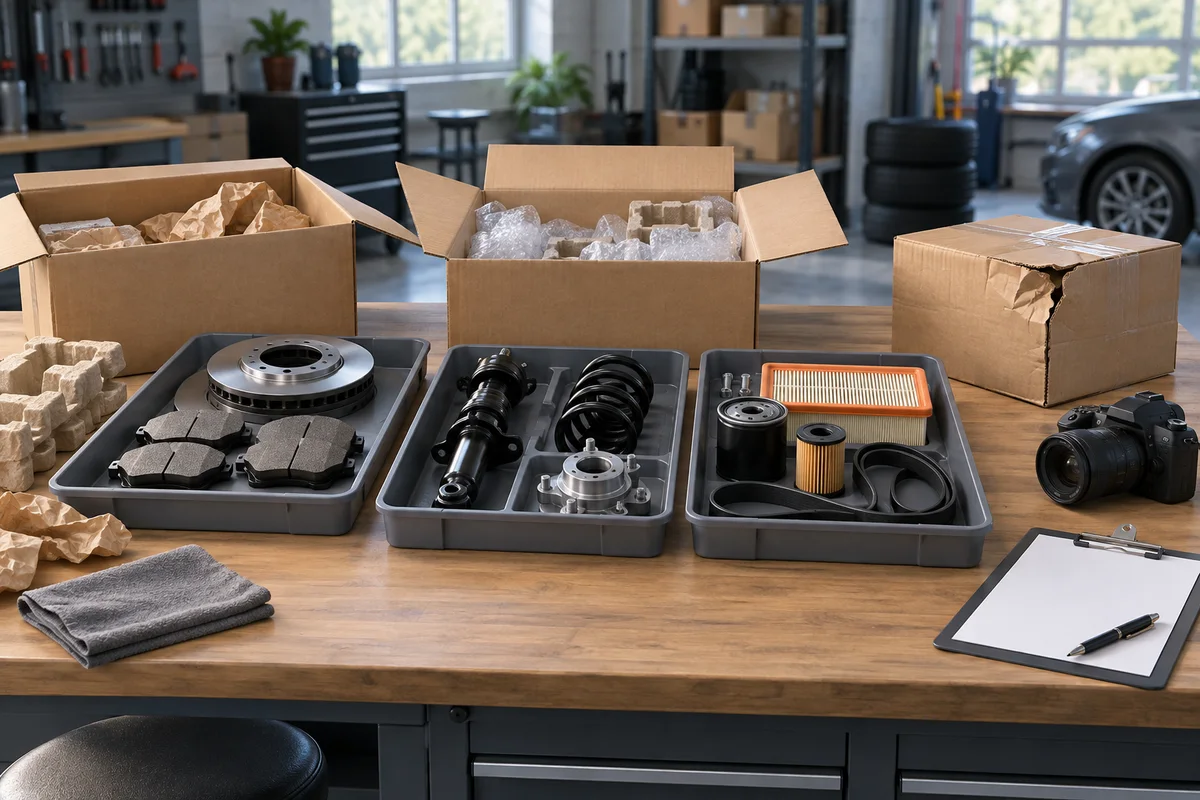
Check the contents of each imported auto-parts carton against the approved order using the same unit. Record exceptions by carton and SKU, and segregate disputed goods. A delivery scan records a reported delivery event; compare it with the cartons actually received. It does not prove that every item is present, undamaged or suitable for the vehicle.
This workflow is for buyers receiving dry, new parts against an already approved specification. It covers quantity and visible condition; technical acceptance requires a separate decision.
Prepare the expected record before delivery
Keep the purchase order, supplier confirmation, final packing list and any consolidation record together. For each line, specify whether the quantity refers to pieces, pairs, bags or complete kits. Include the supplier SKU, your own part ID, approved revision and the quantity in each inner pack.
Request a carton map before shipping, showing the carton ID, SKU, number of inner packs and total pieces. If the warehouse has repacked several supplier deliveries, ask for the new carton IDs and a document mapping the old packs to those cartons. Without that record, you could receive the right goods but check them against the wrong packing list.
Assign someone to receive the shipment and someone to make decisions about exceptions. Set up a holding area and have a camera ready, so disputed goods stay out of available inventory while you assemble the record.
Record the unopened carton
Photograph the shipping label, carton ID, seals and any visible crushing, tears or wet spots before removing the packaging. Record the arrival date, tracking reference and number of cartons physically received. Follow the delivery service's procedure for noting exceptions; a catch-all phrase cannot be assumed to preserve every claim.
Open the cartons carefully to preserve the packing layout. Keep any affected inner pack with its carton record, and photograph the original arrangement before moving the contents. Retain the relevant packaging while the shipper or carrier explains the next step.
Reconcile quantities without double-counting
Use separate fields for the expected quantity, physically counted quantity, shortage, excess, visible damage and held quantity. A damaged item is still physically present. Deducting it from the count can blur the distinction between shortage and damage.
Hypothetical example: the order specifies 10 bags containing 10 trim clips each, or 100 pieces. 9 bags contain 10 pieces and the last contains 6. The count is 96 and the shortage is 4. If 3 of those 96 pieces have visibly broken tabs, and no other pieces are held, available inventory is 93. The record is 4 missing plus 3 damaged, not 7 missing.
| Field | Hypothetical result |
|---|---|
| Expected pieces | 100 |
| Counted pieces | 96 |
| Shortage | 4 |
| Present but visibly damaged | 3 |
| Available after the stated holds | 93 |
Apply this format to each SKU separately. Excess clips of one type cannot automatically offset a shortage of another type, even when their unit prices are the same.
Build an evidence pack that identifies the goods
Link each order line and packing-list row to the relevant photos. Show the part ID or inner-pack label beside the counted contents. A close-up of a broken tab is harder to reconcile when no traceable SKU is visible.
UPS's US claims guidance asks recipients to keep damaged contents and packaging, and to document contents, internal packing, the label, exterior and carton dimensions. Use those categories for that service and confirm your route's requirements. UPS claims guidance.
Keep original files and descriptive names, such as PO-EXAMPLE-C03-CLIP-A-count. Record who counted the goods and whether someone independently checked the disputed line. Protect customer addresses when circulating copies outside the claim team.
Separate a label mismatch from a product mismatch
Investigate a mislabeled bag even if you recognize its contents. Compare the approved specification with the actual marking and the agreed receiving checks. Do not identify and relabel an unknown part from appearance alone.
Sampling can help uncover a problem, but inspecting a few packs does not prove the quantity or condition of all packs. Record which cartons, packs and pieces you inspected. Escalate unexplained differences for wider checking, and do not describe an untouched batch as fully inspected.
A quantity check and visual inspection cannot establish braking performance, electrical compatibility, material strength or vehicle fitment. Keep any required engineering or workshop approval separate from the warehouse count sheet.
Send one concise exception record
Once you have confirmed the discrepancy, use this reusable message:
Order: [PO and revision]. Carton: [ID and tracking reference]. Item: [buyer ID / supplier SKU]. Approved unit: [pieces per bag or kit contents]. Expected: [quantity]. Counted: [quantity]. Missing: [quantity]. Present but damaged: [quantity]. Held: [quantity and reason]. Evidence: [packing-list row and photo files]. Requested next step: [recount, identification, replacement proposal or other agreed remedy]. Please confirm who will manage the carrier inquiry and when a response is due.
Stick to observed facts. A wet box alone does not prove which organization caused the damage, and a shortage could arise during packing, consolidation or delivery. Use the evidence to help investigate the cause without guessing responsibility.
Release inventory with a written decision
Mark each line as released, partly released or held, and identify the decision maker and date. Record replacements separately so their arrival does not erase the original exception. Close the case only after documenting the agreed remedy and stock adjustment.
For the earlier purchase stage, use the supplier-check guide. For designing the order basket, see mixed-SKU replenishment. Keep the receiving record with those documents so the next order starts with a clear history rather than an unexplained stock correction.
Put this guide to work
Working notes to adapt to your order. Keep the approved specification and the cited guidance alongside this sheet.
Use this worksheet when a receiving discrepancy passes from the warehouse to the person deciding the remedy or stock release. Keep the observed condition, the unresolved question and the closure decision together for each disputed order line. A replacement arriving is an event to record; closure still needs the agreed remedy and stock adjustment to be recorded.
Before handing an exception to the next owner
| Check | Record to keep | If unresolved |
|---|---|---|
| Link the disputed item to the documents used at receipt. | Order line, approved revision, packing-list row and carton identity, including any old-to-new carton mapping after consolidation. | Record the missing link as an open question. Do not explain an apparent shortage using a packing list that has not been matched to these cartons. |
| Keep quantity observations and condition observations separate. | Declared order unit, physically counted quantity, counting scope, missing quantity, damaged quantity and quantity on hold. | Clarify the unit or counting scope before changing stock. A damaged item that is present must not also be recorded as absent. |
| Make the evidence usable by someone who did not unpack the goods. | Photo references linking the label, contents and affected packaging to the same item and carton, plus the location of retained goods and packaging. | State exactly which observation lacks a traceable photo or retained material. Do not describe uninspected packs as checked. |
| Name the next decision and the person responsible for it. | Requested remedy, current hold or release decision, decision owner and the record needed to close the case. | Keep the decision open and assign an owner. Receipt of a reply or replacement alone is not the closure record. |
Exception closure worksheet
Complete a row for the disputed order line and attach its evidence references. Write unknown causes as questions, and distinguish a proposed action from an agreed decision.
| Field | What to enter | Decision or handover |
|---|---|---|
| Identity and document chain | [Case reference], [order line and revision], [packing-list row], [carton mapping], [order unit]. | Can the next owner identify the same goods and comparison documents? If not, resolve the missing link before treating the discrepancy as established. |
| Observed exception and check scope | [Counted quantity], [missing or excess quantity], [damaged quantity], [held quantity], [packs actually checked], [photo references]. | Does the record distinguish what was observed from what remains uninspected? Keep an unconfirmed cause separate from the observation. |
| Stock decision and next action | [Current location], [hold or release decision], [decision owner], [requested remedy], [unresolved question]. | Record who may decide the disposition. Quantity or visual checks do not resolve a separate technical acceptance question. |
| Closure evidence | [Written agreement], [replacement or remedy reference], [follow-up receiving record], [stock adjustment record], [closure owner]. | Link the remedy back to the original case. Close only when the agreed remedy and stock adjustment are recorded; leave outstanding questions visible. |
Message for the next exception owner
Please take over [case reference] for [order line and revision]. We compared [packing-list row] with [carton mapping] using [order unit] and checked [inspection scope]. The observed exception is [observation], supported by [evidence references]. Goods and packaging are at [location], with [current hold or release decision]. The cause remains [unconfirmed question]. Please record your decision on [requested remedy] and identify [decision owner]. Any replacement should be linked to this case through [follow-up receiving record]; please return [remedy agreement and stock adjustment record] before marking the case closed. Separate technical acceptance questions remain [open questions].
Sources
Discuss a sourcing request related to this article.Receive auto parts: record shortages, damage and carton evidence