
Grommet RFQ: Groove, Bore and Outside Profile
Define grommet groove diameter, bore, outside diameter and groove width together before comparing an unbranded or custom profile proposal.
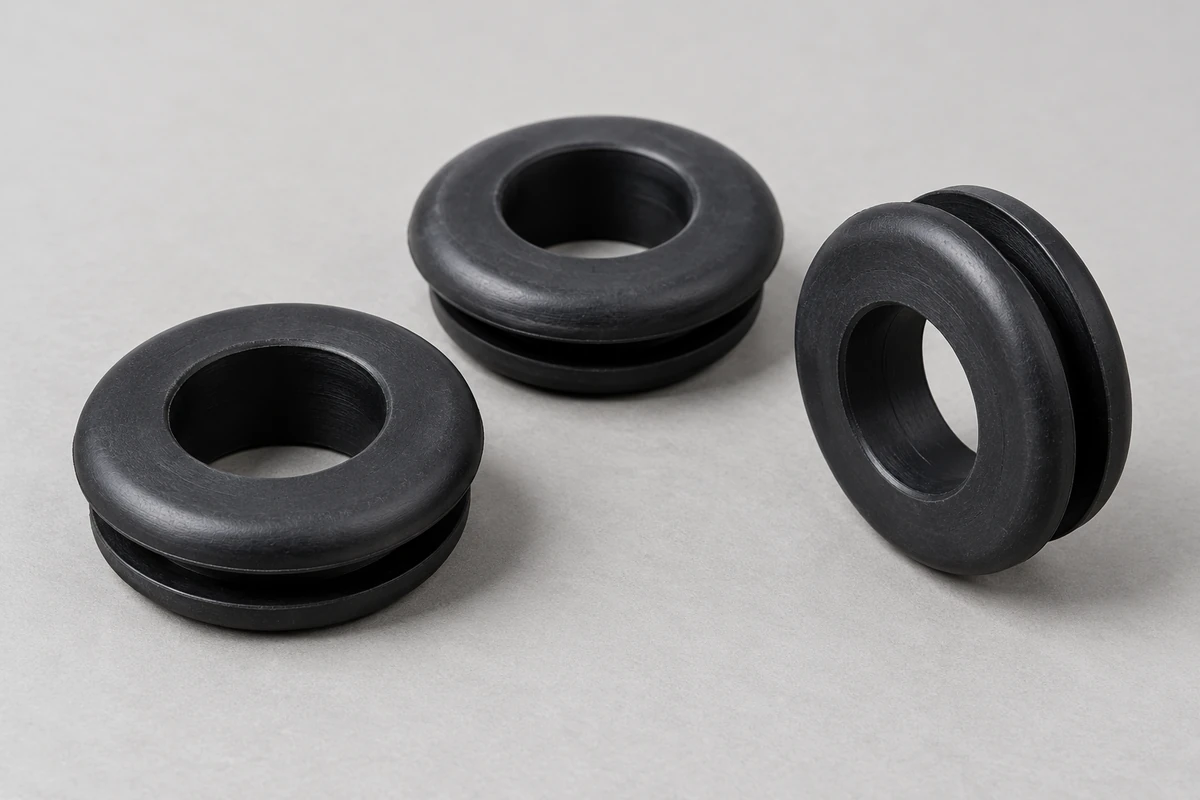
“Half-inch grommet” is not a complete purchasing specification. The fraction might describe the groove diameter, the bore or another feature in a seller’s shorthand. For an affordable custom grommet proposal, identify the complete authorized profile and the actual material requirement before comparing prices.
The buyer’s decision is whether the proposed profile answers the controlled application requirement. A catalogue title containing “firewall” does not establish a universal fire barrier, environmental rating or fit. Keep those separate from the dimensional clarification.
Four dimensions that must stay attached to their names
Steele Rubber Products’ 32-0365-20 listing distinguishes a 1/2-inch groove diameter, 3/16-inch bore, 23/32-inch outside diameter and 1/16-inch groove width. It describes dense EPDM and a historical Buick firewall/vent-control-cable application. Those details belong to the named item; they are not generic dimensions for any half-inch grommet. Steele 32-0365-20 profile
The example shows why one shorthand size cannot stand in for a section profile. The bore and outside diameter name different parts of the shape, while the groove has both a diameter and a width. Copying the numbers without their labels destroys the distinction that makes the information useful.
For a drawing-based RFQ, ask for the required section view and feature callouts from the authorized design record. If the drawing does not establish which feature a dimension names, return that question to the design owner. Do not derive an interference allowance or a panel-cutting dimension from this catalogue example.
Describe the retained interfaces without designing them
Identify the approved panel opening, panel condition and cable or other retained interface information relevant to the requirement. Keep the grommet’s groove dimensions distinct from the receiving panel requirement; do not assume they can be substituted for one another. Likewise, a bore dimension does not authorize a particular cable fit simply because the numbers look close.
Request the supplier’s proposed profile against the drawing revision. If a stock alternative changes the groove width or flange outline, record that actual difference rather than describing the entire product as “same size.” A custom proposal needs the same disclosure: custom does not mean the supplier has automatically accepted or can achieve every requirement.
Material needs its own line. State the buyer’s authorized requirement and the relevant environment for the responsible reviewer. A generic EPDM label cannot, by itself, substantiate oil resistance, heat resistance, fire performance or an effective seal in this application. Ask for the applicable evidence for the actual offered material and condition without inventing a rating.
A profile comparison worksheet
| Profile element | Required reference | Supplier response |
|---|---|---|
| Drawing identity | Authorized part and section-view revision | Acknowledged drawing or proposed stock drawing |
| Groove diameter | Named feature and stated units | Offered value against the same feature |
| Bore diameter | Controlled bore requirement | Offered bore and any declared variation |
| Outside diameter | Authorized external profile | Offered external profile, including differences |
| Groove width | Separate axial-width callout | Offered width, not a repeated diameter |
| Material/environment | Required material and evidence owner | Actual proposed material and evidence gap |
| Application decision | Authorized interface record | Questions requiring responsible acceptance |
This is a purchasing worksheet, not a fit calculator. It deliberately contains no default tolerance, stretch allowance or universal environmental specification. Values should come from the controlled requirement and actual supplier response.
Fictional comparison: matching the wrong half inch
A fictional buyer issues a drawing in which “half inch” is the groove-diameter description. Supplier A offers a stock grommet advertised as half inch but uses that label for its bore. Supplier B returns a drawing that identifies groove, bore, outside diameter and groove width individually, while leaving material evidence incomplete. No real installation or supplier capability is represented.
A’s headline size is not a match to the requested feature. The next question is whether it has a product whose full profile answers the authorized drawing. Do not solve A’s mismatch by changing the panel or cable. B provides a useful geometric basis for review, but material and application acceptance remain unresolved.
If B proposes a different groove width to use existing stock, isolate that proposed change. It is not a harmless price concession simply because all diameters match. The responsible owner must decide whether the alternative can be considered; the buyer should not calculate a new panel condition to accommodate it.
The comparison’s outcome is a targeted clarification for A and a documented evidence request for B. Neither is a product recommendation. It is acceptable for the RFQ to end with no approved candidate when the profile or required evidence remains unanswered.
Negotiate around a known profile
Ask suppliers for same-profile pricing first, and request any existing-stock proposal as a separately dimensioned alternative. If tooling is suggested, ask for its actual scope, feasibility and commercial terms. Do not presume a stock tool exists or that changing rubber will reduce cost without affecting the authorized requirement.
A useful final response identifies all four profile dimensions, the applicable drawing, material proposal and unresolved environmental or interface questions. That lets the buyer discuss affordability without turning an ambiguous size name into a fit or sealing guarantee.
Prepare the sourcing request
For the broader product group, see Body parts. If the application is not established, start with the OE and application identification guide before asking for a substitute.
Use the Autoparts sourcing request to describe the required item and the particular question left open above. The form accepts a description of 8–1200 characters and up to five PNG, JPEG, WebP or GIF images, limited to 10 MiB each and 20 MiB total. It does not accept CAD, PDF or ZIP attachments. Authorized drawing images can start a discussion; arrange other technical files separately through an actually agreed, authorized exchange.
Keep requests for independent aftermarket or unbranded alternatives tied to the authorized application or drawing. Supplier negotiation and a drawing-based proposal do not establish engineering acceptance, actual manufacturing capability or guaranteed savings. Named catalogue products in this article are documentary examples, not branded-goods offers or approvals of an unknown alternative.
Frequently asked questions
What does half-inch grommet mean in an RFQ?
It is incomplete unless the named feature is specified. It may refer to a groove, bore or another seller-defined dimension. Ask for the full authorized profile with the dimensions attached to their feature names, rather than treating the shorthand as a universal size.
Are groove width and groove diameter interchangeable?
No. They identify different profile dimensions and need separate drawing callouts. A quotation that repeats one number in both fields without a controlled reference needs clarification. Do not infer the panel requirement from either field alone.
Does EPDM or firewall wording establish a performance rating?
No. Those labels do not by themselves substantiate the application’s required environmental, sealing or fire-performance claims. Request evidence for the actual offered material and condition, with the responsible reviewer defining the acceptance requirement.
Can I ask for a cheaper stock grommet instead of a custom one?
Yes, as a separately identified proposal against the authorized profile and material requirements. Have the supplier list every changed dimension or material. A similar outside shape or shared nominal size does not approve the alternative or authorize changes to the retained panel or cable.
Sources
Discuss a sourcing request related to this article.Grommet RFQ: Groove, Bore and Outside Profile