
Thermostat Housing RFQ: Define the Assembly Contents
Separate upper and lower housings, thermostat, seals, outlets and hardware so bare-housing prices are not compared with complete assembly offers.
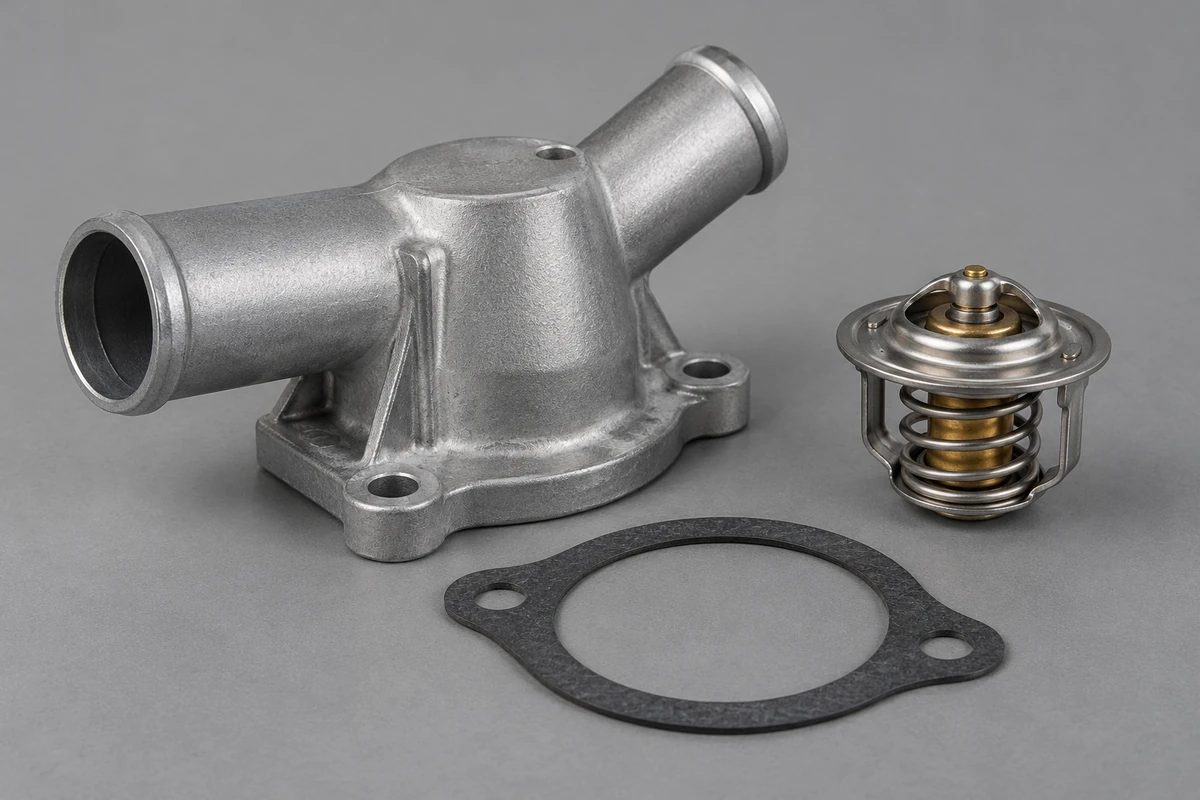
A thermostat housing quote can refer to a bare upper cover, a lower housing or an assembly containing several components. Establish the required supplied object before comparing prices. The lowest housing line is not an affordable version of the same purchase if it leaves out a thermostat or seal that the approved scope requires.
Begin with the application and replacement boundary already authorized by the responsible person. Do not use this quote worksheet to diagnose a cooling-system fault, choose an opening temperature or decide which old components can remain in service.
A contents list can expose a catalogue ambiguity
Dorman’s 902-204 page lists upper and lower housings, a thermostat and a gasket, and identifies a plastic housing with three outlets. Its package description names upper and lower housing bolts, while its mounting-hardware field says No. Preserve that hardware ambiguity as a question; the page does not justify treating all bolts as absent or all mounting hardware as included. Dorman 902-204 specifications
These observations are about one named assembly. Its outlet count and thermostat specification are not selection rules for another application. The example’s value is the separation of components and the need to reconcile exact supplied scope, not permission to copy its configuration into a cheaper alternative.
Ask the supplier for an itemized answer that names each bolt group or other required mounting item. It may distinguish assembly fasteners from other hardware, but that explanation must come from the responsible source. Do not silently invent that distinction as the resolution of the catalogue wording.
Treat the housing halves and thermostat as separate scope lines
Use the approved requirement to identify the upper component, lower component and whether both are supplied together. A quote that covers only a visible upper piece should say so. A photo showing a whole assembly does not establish that the particular price selection includes both halves.
Keep the thermostat requirement attached to its authorized specification source. The question is whether the offered assembly contains the required component, not whether a temperature copied from a nearby listing sounds suitable. Where the thermostat is excluded or offered separately, make that an explicit commercial and technical boundary.
List required seals and gaskets by the appropriate application or assembly reference. “Gasket included” does not settle every sealing item in a larger job. Do not expand the purchase beyond the approved scope, but do identify omissions within it. Purchasing should not assume reuse to make an incomplete quote look economical.
Use a housing-contents worksheet
| Component or interface | Baseline to record | Supplier clarification |
|---|---|---|
| Application/assembly | Approved housing reference | Exact quoted configuration |
| Upper housing | Required or outside this scope | Included component identity |
| Lower housing | Required or outside this scope | Included component identity |
| Thermostat | Authorized specification owner and reference | Included, separate or absent |
| Seals/gaskets | Required items within the assembly boundary | Actual supplied identities and counts |
| Fasteners | Named groups, not just hardware Yes/No | Each included and excluded group |
| Outlets | Authorized arrangement or drawing | Offered arrangement and unresolved differences |
Keep any missing outlet detail open. A shared number of outlets does not establish location, interface or suitability. An authorized drawing can clarify those requirements, but the buyer should not reconstruct them from a catalogue thumbnail.
Fictional comparison: an upper cover is not a complete assembly price
Assume a fictional buyer requires both housing halves, the established thermostat and specified seals. Offer A quotes an upper cover only. Offer B names both halves, thermostat and gasket but says “bolts included, mounting hardware extra” without identifying the groups. These are invented offers, not a representation of a real order.
A is incomplete against the requested assembly. Ask A for the full required scope or retain it as an upper-cover-only proposal. Do not invent a price for the lower half and thermostat and add them to A; their identity and accepted combination would still be unknown.
B has a more complete component list, but the fastener boundary remains unresolved. Ask which exact items its price includes and which required items, if any, are additional. The response must identify the offered configuration rather than merely repeat “complete.” B also still needs the actual application-specific technical evidence required for acceptance.
If the buyer’s authorized scope later changes to upper-cover-only, issue that changed basis explicitly to both suppliers. That is a new comparison, not proof that A answered the original request. Preserve the distinction so that a later purchaser does not order the reduced scope under the old assembly description.
Compare the complete required object without claiming a complete repair
Once the component boundary is understood, request the actual same-scope price and commercial terms. A drawing-based housing proposal or an unbranded assembly can be evaluated only with its own material, component and application evidence. Do not infer availability, tooling capability or guaranteed savings from a supplier’s willingness to discuss a drawing.
Keep the purchasing outcome narrow: which housing parts, thermostat, seals and named hardware are offered, and what questions remain for the responsible reviewer. Calling that record complete describes the quote record, not the safety, fit or completeness of a vehicle repair.
Prepare the sourcing request
For the broader product group, see Cooling parts. If the application is not established, start with the OE and application identification guide before asking for a substitute.
Use the Autoparts sourcing request to describe the required item and the particular question left open above. The form accepts a description of 8–1200 characters and up to five PNG, JPEG, WebP or GIF images, limited to 10 MiB each and 20 MiB total. It does not accept CAD, PDF or ZIP attachments. Authorized drawing images can start a discussion; arrange other technical files separately through an actually agreed, authorized exchange.
Keep requests for independent aftermarket or unbranded alternatives tied to the authorized application or drawing. Supplier negotiation and a drawing-based proposal do not establish engineering acceptance, actual manufacturing capability or guaranteed savings. Named catalogue products in this article are documentary examples, not branded-goods offers or approvals of an unknown alternative.
Frequently asked questions
Is a thermostat housing quote always for both halves?
No. Ask whether the price covers an upper piece, lower piece or the required assembly. List each required component separately, even when the supplier gives one bundled price. Do not let a full-assembly photograph define an ambiguous price selection.
How should I handle bolts listed in contents but hardware marked No?
Preserve both statements and request an itemized clarification naming the included and excluded fastener groups. Do not assume the contradiction means all hardware is supplied or none is supplied, and do not invent the explanation yourself.
Can I choose a thermostat specification from a reference listing?
The actual application and responsible technical owner must establish the requirement. A named catalogue example illustrates how to record contents; it does not authorize an opening-temperature choice or a substitute thermostat for another assembly.
Does the same number of coolant outlets make housings equivalent?
No. Count alone leaves the arrangement, interfaces, component scope and application evidence unresolved. Ask for the actual authorized drawing or product-specific information and record differences separately before comparing a proposed alternative.
Sources
Discuss a sourcing request related to this article.Thermostat Housing RFQ: Define the Assembly Contents