
Door Mirror RFQ: Preserve the Required Function Bundle
Compare adjustment, heating, folding, signals and other required mirror functions before judging a lower-priced replacement assembly.
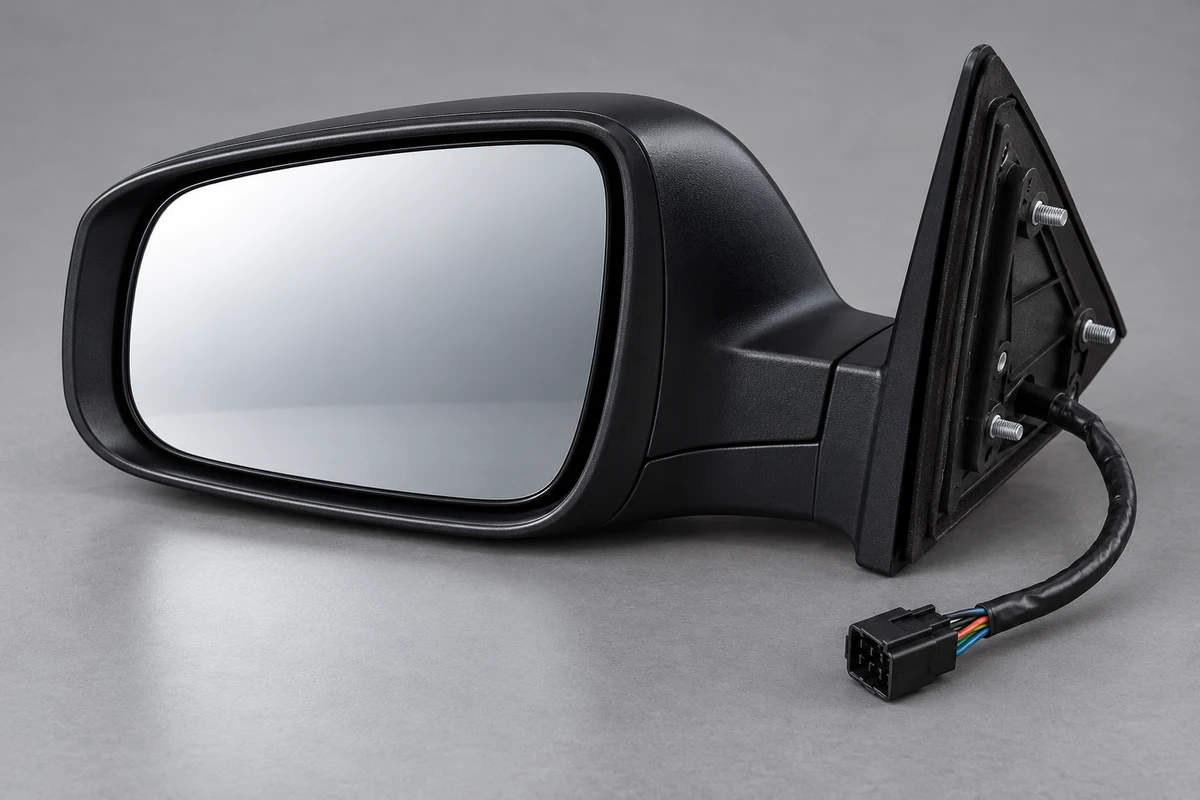
A lower-priced door mirror may have the right silhouette and electric adjustment while omitting another function the vehicle requires. Build the RFQ around the actual function bundle for the specified side and application. “Power mirror” is too broad to serve as the whole specification.
Separate the buyer’s equipment requirement from the seller’s vocabulary. A supplier should answer each required function individually and identify the exact assembly being priced. The exercise is not a retrofit plan and does not authorize removing a vehicle function to make a cheaper mirror acceptable.
Use both the present and absent feature fields
Dorman’s 955-675 listing illustrates the point. It specifies electric adjustment, heating, fold-away capability and turn signals, while automatic dimming, blind-spot indication and memory are marked absent. Wiring harness and mounting hardware are listed as included. The entry’s fold-away field does not establish powered folding. These are bounded observations about one catalogue product, not a compatibility statement for another mirror. Dorman 955-675 specifications
The important purchasing habit is to read the negative fields as carefully as the positive ones. An assembly can truthfully be electrically adjustable while lacking memory. A mirror can be described as folding without documentation of a powered-fold function. Do not allow the word “power” in one field to fill every other field.
For the actual RFQ, carry forward only functions established for the vehicle and intended replacement. Do not copy all the example’s Yes or No values into the request. The fact that a documented product lacks a function says nothing about whether the buyer’s vehicle can omit it.
Split the bundle into answerable requirements
Begin with side, authorized application and the equipment reference used by the responsible reviewer. Then separate adjustment, heating, folding, signals, memory, dimming and blind-spot-related requirements as applicable. If a function is not required, record that decision from the application basis rather than a purchasing guess.
Ask the supplier to describe the folding scope precisely. “Fold-away” and “powered fold” should remain separate terms unless product-specific evidence establishes the latter. A vague “all electric” reply needs clarification, not a favorable interpretation.
Record the glass and housing configuration, harness inclusion and identified mounting hardware where required. An included harness is a supplied component; it is not proof of electrical or control-system compatibility. The same applies to a matching connector photograph. Do not turn quote clarification into connector mapping, coding or a power-connection exercise.
A function-bundle worksheet
| Requirement group | Buyer baseline | Supplier answer to preserve |
|---|---|---|
| Side and application | Exact authorized reference | Offered assembly and variant |
| Adjustment and heating | Required functions stated separately | Included, absent or unresolved for each |
| Folding | Required folding type | Exact offered folding description and evidence |
| Signals | Required indicator arrangement | Which indicator functions are supplied |
| Memory, dimming and related equipment | Actual vehicle-specific requirements | Individual response for each required item |
| Supplied components | Harness and hardware scope | Itemized inclusion or exclusion |
| Open control questions | Review owner and evidence needed | Product-specific documents, with gaps visible |
Do not total the number of Yes responses as a quality score. One omitted required function matters more to this decision than several irrelevant extras. A richer feature list also does not establish that an assembly is compatible with the buyer’s vehicle.
Fictional comparison: two descriptions of “power”
Imagine a fictional request for a particular side with an authorized bundle that includes adjustment, heating and powered folding. Offer A says “power heated mirror, fold-away.” Offer B explicitly states adjustment, heating and powered folding, but its harness and control evidence are not supplied. Neither offer is a real supplier record.
A has not answered the powered-fold requirement. The buyer asks whether that specific offered SKU provides the required function and requests supporting detail. A’s wording must not be normalized as a matching Yes. If the supplier confirms only a manually movable housing, the response is a functional deviation from this fictional baseline.
B is more explicit about the claimed functions, but the remaining evidence gap keeps it conditional. The buyer requests the missing assembly-specific information; a clear sales description is not technical acceptance. If B supplies evidence for a different variant, the question remains unresolved even if the photograph looks identical.
The buyer can now distinguish a lower-price changed-function proposal from an incomplete same-function proposal. That is more useful than selecting whichever line says “complete assembly” or has the most attractive photograph.
Negotiate a same-function alternative
Ask for the price of the required bundle first. A supplier may separately propose a different housing finish or another commercial arrangement, but its impact on the authorized requirement must remain explicit. Do not assume that a drawing-based proposal preserves invisible control functions just because its outer shape is specified.
Keep each alternative’s included harness and hardware tied to its own quotation. A follow-up message about optional hardware should not be blended into an earlier price that excludes it. Request a consolidated response once the scope is clear.
The purchasing decision ends with a documented function bundle, actual offered assembly and named unresolved questions. Vehicle-system acceptance remains with the responsible technical reviewer. An affordable aftermarket proposal earns consideration by preserving required scope and substantiating it, not by borrowing the example manufacturer’s claims.
Prepare the sourcing request
For the broader product group, see Body parts. If the application is not established, start with the OE and application identification guide before asking for a substitute.
Use the Autoparts sourcing request to describe the required item and the particular question left open above. The form accepts a description of 8–1200 characters and up to five PNG, JPEG, WebP or GIF images, limited to 10 MiB each and 20 MiB total. It does not accept CAD, PDF or ZIP attachments. Authorized drawing images can start a discussion; arrange other technical files separately through an actually agreed, authorized exchange.
Keep requests for independent aftermarket or unbranded alternatives tied to the authorized application or drawing. Supplier negotiation and a drawing-based proposal do not establish engineering acceptance, actual manufacturing capability or guaranteed savings. Named catalogue products in this article are documentary examples, not branded-goods offers or approvals of an unknown alternative.
Frequently asked questions
Does power mirror mean powered folding?
No. Electric adjustment does not establish a powered-fold function. Ask the supplier to identify the folding type separately and provide evidence for the actual offered assembly. A fold-away description alone should remain unresolved if powered folding is required.
Should I copy every feature from a reference mirror catalogue?
Use the actual vehicle equipment and authorized application to define the requirement. A named catalogue example shows how features can differ; it is not a universal bundle. Keep required, not required and unknown states separate for your application.
Does an included wiring harness prove mirror compatibility?
No. Harness inclusion is a contents statement. It does not establish that the assembly preserves the required electrical and control functions. Keep product-specific compatibility evidence separate and avoid connector-only assumptions or adaptation proposals.
How can suppliers quote an affordable mirror alternative fairly?
Ask each to quote the same required function bundle, side and application, with harness and hardware scope explicit. Record any changed-function proposal separately. A lower price is not a matching comparison if it silently removes heating, folding, signaling or another required function.
Sources
Discuss a sourcing request related to this article.Door Mirror RFQ: Preserve the Required Function Bundle