
Drain-Plug Assortments: Reorder the Depleted Reference
Compare a confirmed refill offer with a whole drain-plug assortment while keeping component identity, pack terms and unwanted remainder explicit.
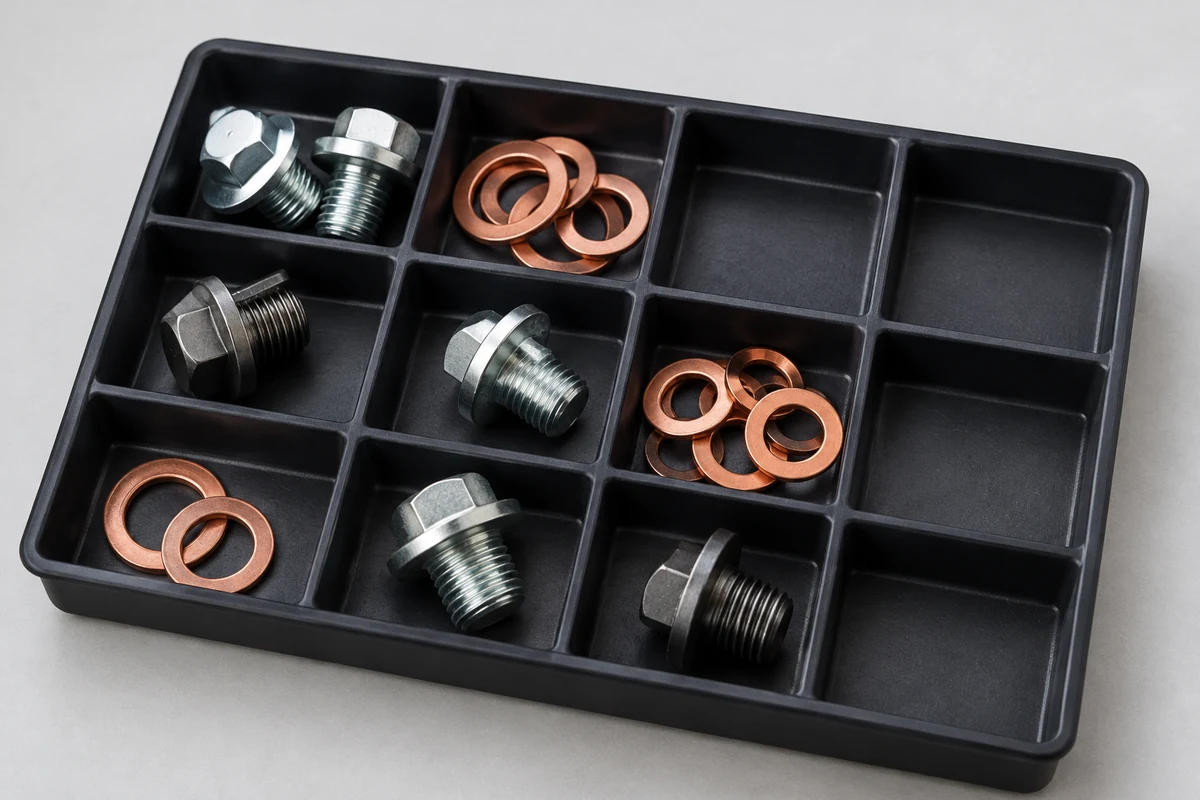
An assortment can be mostly full and still fail its next approved requirement because one reference has been depleted. The useful question is whether that exact reference is separately orderable now, on acceptable terms, rather than whether another complete case would look more orderly.
Begin with identified remaining stock and approved replacement requirements. Do not identify a depleted drain-plug line from an empty compartment's position or from another plug with matching thread dimensions.
Identify the actual assortment before asking for a refill
Elring's current assortments page clearly identifies 777.100 as an oil-drain-plug assortment. The same page labels 812.410 as a fastener assortment but uses conflicting oil-drain wording for a lower flyer entry. Checked on 14 October 2026, it supports the existence of an oil-drain assortment, not treating those two references as the same product. Elring assortments
For a refill enquiry, name the actual case and exact component reference from its attributable contents record. Keep the page's inconsistent labeling unresolved rather than borrowing a convenient component count from the 812.410 flyer. Neither the category page nor a historical list proves the current contents of the buyer's case or the present availability of individual refills.
Carry the actual case reference and issue into the inquiry. Ask which current component reference corresponds to the depleted line and whether it is offered individually or in a dedicated refill unit. If the provider reports a changed reference, obtain the responsible application decision; do not treat a catalogue update as automatic substitution approval.
Equal thread descriptions do not establish identical plugs. The refill must answer the approved reference and its qualifications. A visually similar item from the next compartment cannot supply that evidence.
Confirm the offer before comparing the arithmetic
For the refill, request the exact supplied reference, pieces per purchase unit, actual minimum and increment, and the complete current commercial offer. If the seller has not confirmed separate supply, leave that route unquoted. A hypothetical low refill price cannot make the complete assortment economically inferior.
For the whole-case route, obtain its current contents, including the count of the depleted reference. Compare that count with the known gap. Keep the other lines' current balances and authorized needs visible; a new case may replenish several real shortages or add quantities with no identified use.
Do not assign future use simply because the original assortment was convenient. Any expected consumption belongs in a separately stated scenario, with its own approved assumptions. Neither route proves a supplier will meet a need date without an actual commitment.
Build the depleted-line worksheet
| Field | Record to obtain |
|---|---|
| Case issue | Actual assortment reference and contents version |
| Component reference | Attributable depleted item, with application already approved |
| Remaining line count | Eligible matching pieces actually available |
| Confirmed refill unit | Exact separately offered item and pieces per unit |
| Minimum purchase | Supplier-confirmed minimum and order increment |
| Unwanted remainder | Extra depleted-line pieces plus extra other references |
The worksheet is a purchase comparison, not a compartment redesign. Preserve existing product associations and identification. It gives no permission to mix unverified plugs, select seals or reconstruct a kit from a photograph.
Fictional comparison: a refill creates a smaller remainder
Suppose an invented assortment contains five approved lines, originally ten pieces each. Line A now has two eligible pieces, while the other four lines each retain nine. Eight A pieces are required for authorized jobs. The immediate gap is six A pieces; there is no current demand for the other lines.
Offer R is a confirmed ten-piece refill of approved A. Offer C is a confirmed new case containing ten of each of the five lines. R supplies six needed pieces and leaves four additional A pieces. C leaves the same four A pieces plus forty pieces across the other lines. These are fictional formats and quantities, not a reconstruction of Elring's assortment.
R has the smaller incremental remainder, but no price preference follows until complete actual offers are compared. If R is unavailable, the buyer may consider C with its known surplus or seek another approved offer. Do not report R as a purchasable saving merely because its arithmetic is attractive.
If a later count finds another six eligible A pieces, no A purchase is needed for these eight jobs. The original depleted appearance should not drive an unnecessary refill after the evidence changes.
Leave the next buyer a component-level record
Record the chosen unit, confirmed reference and expected remainder, then reconcile the actual receipt separately. Keep the case issue as context without letting it erase the identity of the refill. A future buyer should be able to distinguish a genuine repeated shortage from an outdated case count or an unsupported contents assumption.
Request the identified replenishment
See Engine parts for category context. In an Autoparts sourcing request, identify the approved product and the unresolved replenishment question. The form accepts an 8–1200-character description or supported marketplace link, and up to five PNG, JPEG, WebP or GIF images, limited to 10 MiB each and 20 MiB total. Other technical files need a separately agreed, authorized exchange; the image field is not a PDF, CAD or ZIP portal.
Named manufacturer products are documentary examples, not branded supply offers, affiliation or evidence that another supplier can make or validate an alternative. Independent buying coordination and supplier negotiation do not establish fit, safety approval or guaranteed savings.
Frequently asked questions
Does a manufacturer assortment list prove individual refills are sold?
No. It can identify a line to ask about, but separate current orderability, pack size and terms require an attributable provider response. Preserve the list’s date and confirm that it matches the actual case issue.
Can equal thread dimensions identify the depleted plug?
No. Use the established component reference and application evidence. A shared thread description does not settle all product differences, and an empty compartment or similar appearance does not establish a refill identity.
Is a refill necessarily cheaper than buying the whole assortment?
No. Compare actual complete offers after confirming both formats. Show the quantities beyond current need, but do not invent resale credit, future consumption, delivery charges or availability to make either route win.
What if no separately orderable refill is confirmed?
Keep the refill route unresolved or unavailable according to the actual response. Compare only supported alternatives, including a complete case with disclosed leftovers. Do not substitute another reference without the responsible product approval.
Sources
Discuss a sourcing request related to this article.Drain-Plug Assortments: Reorder the Depleted Reference