
Combined Engine Gasket Sets: Preserve Head and Conversion Set Boundaries
Keep head and conversion gasket set references traceable when combining an approved order, so exclusions, overlap and possible packing losses remain distinguishable.
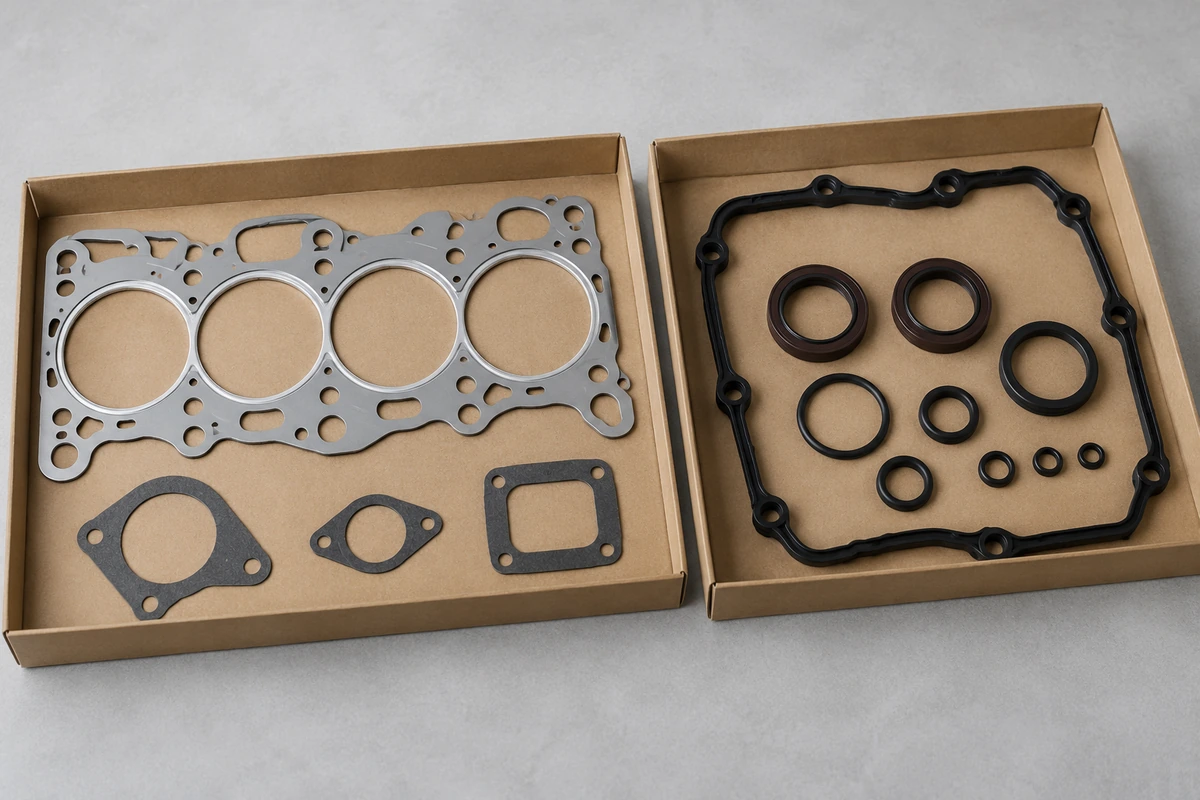
Combining an approved head set and conversion set into one engine-gasket package should not erase the two source-set identities. If a later question concerns one seal, the buyer needs to distinguish what each set was agreed to supply from what the combined package actually accounts for. A new full-set label cannot create that evidence.
Start with the combination and application already accepted by the responsible product owner. This article reviews how its source boundaries survive packing. It does not authorize substituting two sets for a full set, define an engine-overhaul contents list or decide which gaskets a repair requires.
A combination keeps two evidence sources
Elring’s English gasket-set FAQ says a head set and conversion set can be combined where it does not offer a full engine set. It also says exact parts lists are not public and directs attention to catalogue deviations and specific inquiries. Checked on 14 October 2026, this is context for asking the actual provider about an approved combination, not proof that any chosen pair is complete. Elring gasket-set FAQ
Retain the exact accepted head-set and conversion-set references, including applicable versions or catalogue qualifications. Use the provider’s own set terminology rather than inferring a precise upper-engine or lower-engine boundary from the names. The actual inclusion answer must come from the evidence for those references.
A parts-list access limit should remain explicit. If a provider does not disclose a complete internal list, ask it to answer the specific inclusion or overlap question for the approved pair. A scoped response may resolve the buying issue without pretending that a public bill of materials was available. An unanswered question should remain unanswered in the pack record.
Distinguish three different explanations for a missing-looking item
First, the item may be outside the accepted combination. A documented exclusion needs to remain visible when the two sets share a package, so that the recipient does not interpret a broader label as an expanded purchase.
Second, the provider may have confirmed that the item belongs to one of the source sets, while the proposed combined-pack record fails to account for it. That is a specific packing or supply discrepancy to resolve against the named source set. Do not assign blame or claim physical loss before the evidence establishes what happened.
Third, inclusion may never have been established. A photograph of an unfamiliar seal cannot fill that gap, and an engine-overhaul label does not answer it. Ask the responsible provider for a product-specific response rather than declaring either a shortage or a complete package.
These explanations lead to different next questions. Keeping the source references intact prevents them from being compressed into a generic missing gasket complaint with no agreed baseline.
Do not delete apparent duplicates during consolidation
Two source sets may appear to contain similar items. That observation does not establish exact identity, approved overlap or permission to remove one. Ask the provider whether there is a confirmed duplicate and what the accepted combined supply is intended to include.
If the buyer agreed to purchase both complete sets, a packer should not silently reduce the supplied contents under a tidying instruction. A changed quantity or exclusion requires an explicit commercial and product-scope decision. Conversely, do not promise duplicate spares where no overlap has been confirmed.
Keep the answer attached to the source pair. A response about one head-set/conversion-set combination should not be applied to another engine reference merely because both use the same family names. Packaging consolidation must preserve the accepted evidence, not generalize it.
Build a source-set boundary record
The following original editorial worksheet helps resolve a combined packing proposal. It is not a universal gasket schedule or an assembly guide.
| Field | Evidence to keep |
|---|---|
| Approved combination | Application/scope reference and responsible acceptance owner |
| Head-set identity | Exact supplied reference and its applicable qualification |
| Conversion-set identity | Exact supplied reference and its applicable qualification |
| Specific inclusion question | Item or group being queried, without an invented requirement |
| Confirmed overlap or exclusion | Provider response for this exact pair, including unknowns |
| Combined-pack relationship | How both source identities remain attributable after consolidation |
| Open discrepancy | Whether inclusion, allocation or actual supply remains unresolved |
The combined package can have its own administrative reference while retaining both source references beneath it. That administrative label should not impersonate a manufacturer’s full-set SKU or imply that the provider created a new validated product. Ask the supplier to identify which description is manufacturer-issued and which belongs only to this commercial grouping.
Fictional example: one questioned seal, two possible records
Assume a fictional approved combination consists of head set H-A and conversion set C-A. A packer proposes placing their contents in one presentation package and retaining only a new label E-A. Later, the buyer asks whether queried seal Q belongs to the ordered supply. All references are invented; Q is not a recommendation that any real engine needs a particular seal.
If H-A and C-A remain traceable, the provider can answer the inclusion question against the actual pair. Suppose it confirms that Q was excluded from the accepted combination. The buyer records that boundary and corrects any misleading description. Whether to buy Q is a separate authorized product decision, not a packing correction.
Alternatively, suppose an attributable earlier response confirms that Q belonged to C-A. The pack record now has a concrete discrepancy: it needs to account for that confirmed item under the C-A relationship. A photograph of the combined package alone cannot establish whether Q was omitted, concealed or supplied elsewhere. The provider needs to resolve the actual supply record.
If both original set references were discarded and E-A has no cross-reference, even the correct inclusion question becomes harder to direct. The buyer should seek the original provider records before concluding that the package is complete. A plausible replacement set reference would create false certainty rather than restore the evidence.
Close the pack boundary without broadening the repair claim
Approve the combined packing record only against the accepted pair, the preserved source identities and the resolved questions that matter to that offer. Keep unanswered inclusion or supply issues visible with an owner. A complete record can describe a deliberately limited purchase; it does not mean every part needed for an engine repair has been supplied.
For context, see Engine parts and how we check an auto-parts supplier. Use the Autoparts sourcing request to identify both accepted set references and the specific boundary question. It accepts 8–1200 characters and up to five PNG, JPEG, WebP or GIF images, at most 10 MiB each and 20 MiB total. PDF, CAD and ZIP documents require a separately agreed, authorized exchange. The Elring example implies no affiliation, branded-goods offer, supplier capability or approval of another set combination.
Frequently asked questions
Can a head set and conversion set always replace a full engine gasket set?
No universal substitution follows from the example. The actual application and exact pair require the responsible product owner’s acceptance before this packing review begins. Preserve the approved combination and its stated limits rather than choosing sets from their names alone.
What if the provider does not publish a complete parts list?
Keep that evidence limit visible and ask a specific inclusion, exclusion or overlap question about the exact accepted pair. An attributable scoped answer may resolve the issue. Do not invent a list from product photos or present a general catalogue statement as proof of every included gasket.
May the packer discard a gasket that looks duplicated across both sets?
Appearance does not establish identical parts or permission to reduce the purchased supply. Ask the provider to confirm any overlap and the intended combined contents. If the accepted order includes both complete sets, an omission requires a separately authorized change rather than a cosmetic packing decision.
Does an absent-looking seal automatically mean it was lost in packing?
First establish whether that seal was included in the accepted source pair. Confirmed exclusion, unknown inclusion and unaccounted-for included supply are different findings. Preserve both source references so the provider can resolve the correct question without guessing from the combined package alone.
Sources
Discuss a sourcing request related to this article.Combined Engine Gasket Sets: Preserve Head and Conversion Set Boundaries