
Cabin-Filter Reorders: Recheck the Media Demand Mix
Separate committed demand and eligible stock by approved cabin-filter media line before repeating a historical total or assortment ratio.
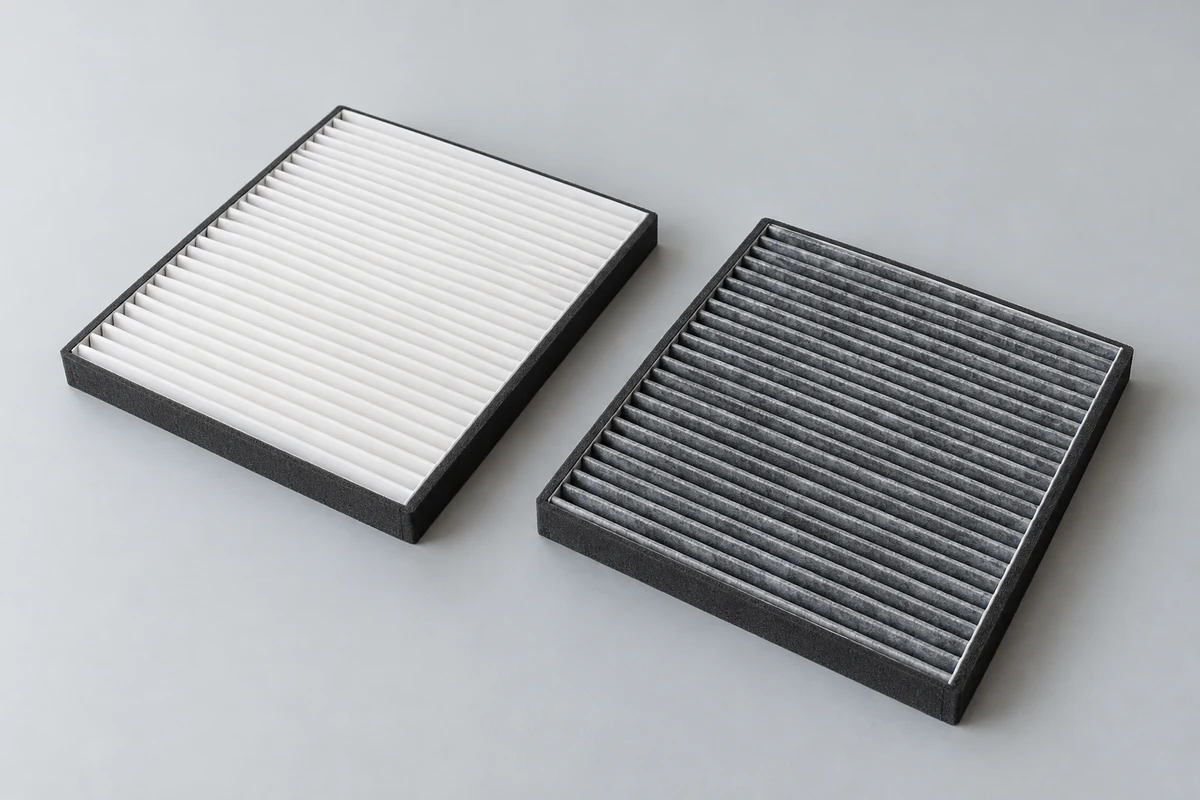
Last year's total cabin-filter consumption can remain unchanged while the current requirement shifts between approved media lines. Repeating the old ratio may create surplus in one line and a shortage in another. Start with the current committed mix, then compare historical activity as a separate planning input.
This article assumes each offered media line is already accepted for its specific application. It does not recommend an upgrade, make health claims or approve cross-line substitution because two filters share an envelope.
Media descriptions identify different purchase lines
MANN-FILTER's FreciousPlus page distinguishes particle, activated-carbon and biofunctional layers in that named line. Reopened on 14 October 2026, it is used here only to illustrate that media construction is part of product identity. No filtration percentage, health outcome or performance claim is transferred to another filter. FreciousPlus media description
For replenishment, retain the exact accepted SKU and media description. A shared vehicle application or external size should not turn different media lines into one stock pool. If the customer or product owner has authorized more than one option, record the actual selected line for the obligation.
An apparent trend may come from a naming change rather than changed demand. Reconcile renamed SKUs and issue units before interpreting last year's counts. Avoid combining “carbon,” a brand family name and an unspecified filter under one historical category without confirming what those entries represented.
Separate commitments from scenarios
Create a current demand view by approved application and media line. Keep confirmed bookings or orders separate from uncommitted expectations. If the owner wants a scenario using the old mix, show it beside the current commitments rather than replacing them.
A forecast ratio is an assumption, not a product fact. Record who selected it and the period it covers. Do not derive future sales from a manufacturer's marketing page or claim that a more elaborate media description will automatically increase demand.
Apply eligible matching stock to each line once. Stock committed to another customer remains tied to that obligation unless an authorized allocation changes it. An excess in one line cannot numerically offset a shortage in another unless the actual customer and product permissions support the change.
Build a media-mix worksheet
| Field | What to retain |
|---|---|
| Application | Exact approved vehicle/application boundary |
| Approved media line | Accepted SKU and selected construction |
| Historical issues | Corrected counts and original period |
| Current committed mix | Unique approved obligations by line |
| Eligible matching stock | Same-line supply available to this demand |
| Scenario remainder | Coverage and extra units under each stated buy |
Keep the output in individual filters before converting to actual supplier packs. If a mixed-case offer forces a ratio, expand it by line and show both the remaining shortage and extra units. A large total case count does not prove the chosen media mix is covered.
Fictional example: the same total, a different purchase
Assume a fictional previous period issued 80 filters from approved line P and 20 from approved line C for one established application family. Current committed requirements total 100 again, but comprise 40 P and 60 C. There are 20 eligible P filters and 10 eligible C filters available to those commitments.
The uncovered quantities are 20 P and 50 C. Repeating the previous 80/20 purchase would leave 60 P beyond the current P gap while still leaving 30 C uncovered. These invented lines are not MANN-FILTER products, and the example predicts no market preference.
Suppose a seller offers a mixed case with ten P and ten C. Five cases cover the 50 C shortage but supply 50 P, creating 30 P beyond the 20 P shortage. A separately confirmed line-specific offer may yield a different remainder. Compare actual complete terms; do not assume the lower-surplus route exists or costs less.
If a customer later approves P for a defined subset previously assigned to C, update only those obligations under that recorded permission. The surplus alone does not grant permission, and the changed allocation must not be described as equivalent filtration.
Keep the next repeat grounded in actual choices
Retain the chosen purchase split, the confirmed offer composition and the reason for any deliberate surplus. Record subsequent issues against the actual selected line so future history remains meaningful. If demand is only a scenario, label it accordingly in the reorder proposal.
This method makes a changing assortment visible without inventing a preference, upgrade path or substitution. The buyer can negotiate the right line quantities while leaving application and performance acceptance with their proper owners.
Request the identified replenishment
See Body parts for category context. In an Autoparts sourcing request, identify the approved product and the unresolved replenishment question. The form accepts an 8–1200-character description or supported marketplace link, and up to five PNG, JPEG, WebP or GIF images, limited to 10 MiB each and 20 MiB total. Other technical files need a separately agreed, authorized exchange; the image field is not a PDF, CAD or ZIP portal.
Named manufacturer products are documentary examples, not branded supply offers, affiliation or evidence that another supplier can make or validate an alternative. Independent buying coordination and supplier negotiation do not establish fit, safety approval or guaranteed savings.
Frequently asked questions
Can last year’s filter total determine the next order mix?
Not by itself. Split corrected historical issues by approved media line and compare them with current commitments. The same total can conceal a different mix, so apply matching stock and calculate each line’s gap separately.
Can extra particle-line stock offset another media-line shortage?
Only where the actual product and customer authorizations permit the defined allocation. Shared size or application wording is insufficient. Keep the shortage visible until that decision exists rather than assuming all media lines are interchangeable.
Does FreciousPlus marketing prove demand for an alternative?
No. The cited source supplies a named media-construction distinction only. It establishes neither demand forecasts nor health or performance claims for another product. Scenario ratios need their own explicit owner-selected assumptions.
How should a supplier’s mixed media case be compared?
Expand its confirmed contents into exact line quantities, apply them to the line-specific shortages and show the remainder for each. Compare complete current offers without treating unused filters as guaranteed future sales or savings.
Sources
Discuss a sourcing request related to this article.Cabin-Filter Reorders: Recheck the Media Demand Mix