
Drum Brake Kit Packaging: Preserve the Approved Preassembled Groups
Review smaller-pack proposals against the drum brake kit’s actual preassembled shoe groups, loose components and approved delivered state before release.
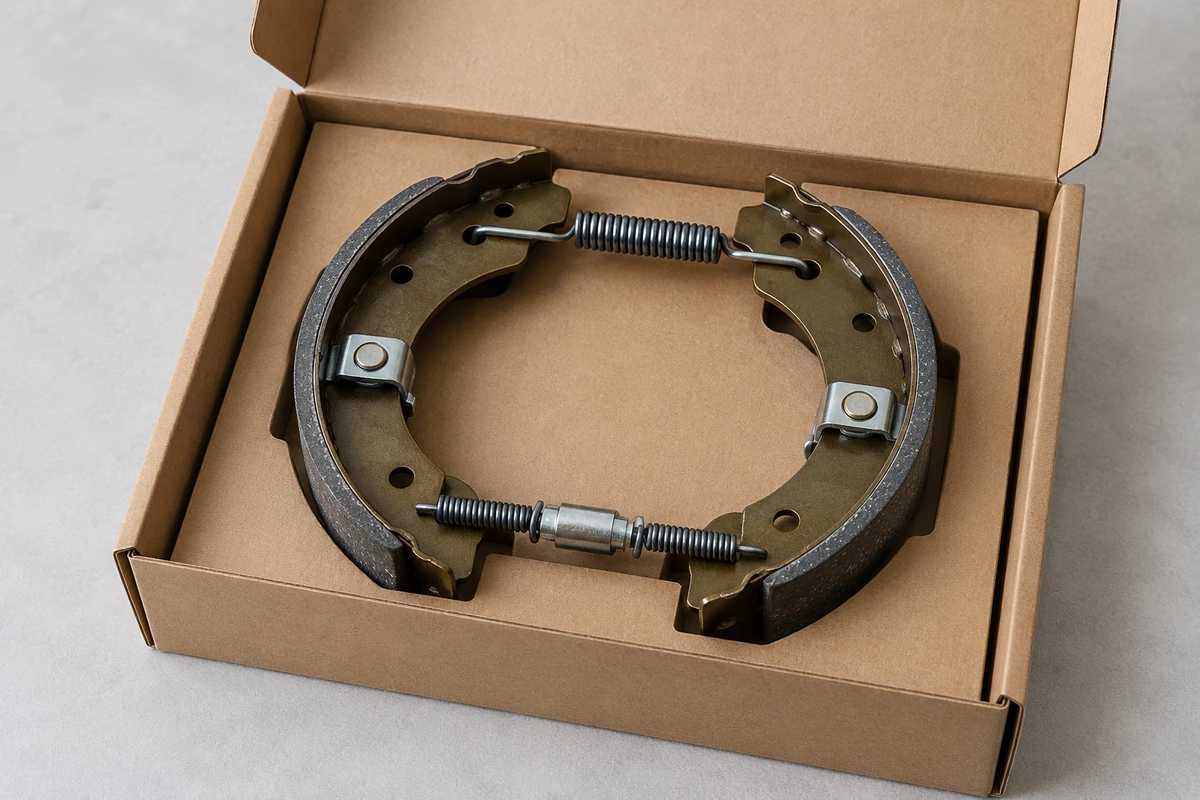
A smaller drum-brake package may be offered with the same named components but a different supplied state. Before accepting it as a packing change, identify which brake-shoe groups were purchased preassembled and whether the proposal would turn them into loose parts. The commercial unit includes the agreed assembly state as well as the component identities.
A preassembled kit can also contain separately supplied items. The buyer needs that distinction at the group level. Requiring every item in the box to be physically connected would invent a product requirement; accepting every item loose would erase an agreed one.
Find the assembly boundary within the kit
ZF’s global English drum-brake page describes TRW Superkits containing preassembled, preadjusted shoe groups alongside cylinders, adjusters and associated items. Checked on 14 October 2026, the named example shows why a kit’s supplied state needs more detail than a list of pieces. No TRW testing, homologation, performance or repair-time claim is extended to another product. TRW Superkits description
For the actual order, use the supplier’s accepted configuration record. Identify the shoe groups supplied as assembled units and the components supplied separately. Retain any approved position or group distinctions already present in that record, without assigning them from appearance or inventing an axle-wide contents rule.
The term complete must have a defined object. It might refer to the ordered kit, an assembled shoe group within it or a quantity of loose accessories. Keep those levels separate in the correspondence. A complete list of loose items does not describe an assembled group, while an assembled group alone may not account for the entire purchased kit.
Ask what the smaller-package proposal changes
Have the proposer describe the final supplied state rather than only the proposed carton dimensions. Does the new layout preserve the existing shoe groups? Does it separate items that are already loose in the accepted configuration? Or does it require dismantling a supplied group to reduce its envelope?
The first two questions can remain packaging-scope questions when the approved product state is unchanged. The third is a change to what reaches the buyer and requires a separate product and commercial disposition. Avoid a vague promise that everything will be included, because that leaves the purchased assembly work unaccounted for.
A proposed photograph should be read on the same basis. Several loose parts arranged in the outline of a shoe group do not establish that the group is supplied assembled. Conversely, a separately boxed cylinder should not be classified as a packing failure where the actual approved kit intentionally supplies it loose. Compare the proposal with its own accepted baseline.
Keep assembly-state evidence separate from component counts
The following worksheet is an editorial aid for reviewing the purchase and packing records. It is not a brake inspection procedure and does not define adjustment, assembly or acceptance values.
| Group in the actual order | Existing approved state | Proposed delivered state | Decision needed |
|---|---|---|---|
| Each identified shoe group | Provider-confirmed assembled scope | Retained or explicitly changed | Does the proposal preserve the purchased group? |
| Separately supplied components | Accepted loose-item references | Proposed location and identity | Are these still the same ordered loose items? |
| Associated accessories | Approved groups and inclusion | Unchanged, deferred or substituted | Which commercial contents remain unresolved? |
| Configuration record | Exact reference and issue | Record covering the current proposal | Is the evidence about this supplied state? |
| Product-state change | No assumption of permission | Exact requested change | Who is authorized to decide and what remains open? |
Do not use the table to demand that a packer expose concealed components. Existing attributable records and the provider’s stated configuration may support the documentary review. If further evidence is needed, the responsible product provider should define the permitted route.
Where a supplier offers a different, loose-parts kit as an alternative, keep it separately identified. The buyer may choose to seek a new evaluation, but it should not be entered as the original preassembled line with a cheaper shipping note. Its contents, technical acceptance, responsibilities and commercial terms need their own decision.
Fictional example: preserve the shoe groups, distinguish the loose cylinders
Assume a fictional approved kit D-Set contains two identified preassembled shoe groups and two separately supplied cylinders, plus the agreed accessory group. The numbers and references are invented solely to illustrate this purchase; they do not define a universal drum-brake kit.
Proposal One places the two intact shoe groups and the already separate cylinders in a revised package. Its physical protective design still requires the appropriate provider’s review, but the written proposal describes the same product-state boundary as the order.
Proposal Two lists the same component names, with all shoe-group components supplied loose to fit a smaller parcel. It answers the piece-list question but changes the purchased state. The buyer asks whether the supplier can retain the approved groups in another package before considering a separately identified changed supply.
The supplier says that the cylinders were loose anyway, so the whole kit should be acceptable loose. That argument crosses the group boundary. The original record authorized loose cylinders and assembled shoe groups; it did not authorize either state for every item indiscriminately.
If the supplier cannot identify which state it proposes for the shoe groups, the affected packing change remains unresolved. A promise that the recipient can put it together later transfers an undefined task and cannot close the purchased-state question. This article provides no reassembly or adjustment instructions and makes no claim that the altered components are equivalent or defective.
Close the actual delivered-object decision
The final packing response should name the retained assembled groups, the accepted loose items and the configuration reference covering them. Any later substitution of a loose-component supply should reopen the product-state decision. The receiver then has a clear description of what was agreed, rather than a retrospective argument over the word kit.
This review does not establish brake performance, vehicle suitability or regulatory compliance. Source examples are documentary context, not branded-goods offers, supplier endorsements or evidence that a buying agent can assemble or validate brakes.
See Brake parts and how we check an auto-parts supplier. In the Autoparts sourcing request, identify the approved group and the proposed supplied-state change. The form accepts an 8–1200 character description and up to five PNG, JPEG, WebP or GIF images, at most 10 MiB each and 20 MiB combined. Arrange PDF, CAD and ZIP files separately through an actually agreed, authorized exchange.
Frequently asked questions
Does preassembled mean every part in a drum-brake kit is connected?
No. The actual accepted configuration must identify the assembled groups and any separately supplied components. Keep that distinction at group level. A loose cylinder or accessory is not automatically a discrepancy, and a broad preassembled label does not authorize treating all shoe-group components as loose.
Can identical component counts justify a loose-parts repacking proposal?
Counts account for membership but do not establish the purchased assembly state. If the proposal dismantles an approved supplied group, keep it as a changed product-state request. Ask for an unchanged-state packing alternative or a separate authorized evaluation of the proposed supply.
Can an unbranded kit use the TRW example as assembly approval?
No. The named manufacturer description illustrates a supplied-state distinction. Another kit needs its own exact configuration, product evidence and responsible acceptance. It cannot inherit TRW’s assembly, adjustment, testing, homologation or performance claims because its component list looks similar.
What evidence closes the packing question without a brake procedure?
Obtain an attributable response identifying the actual retained groups, separately supplied items and current packing revision. Record unresolved changes for the product owner. That can close the documentary scope while physical protection and technical acceptance remain with the agreed competent providers; no brake adjustment or reassembly step is implied.
Sources
Discuss a sourcing request related to this article.Drum Brake Kit Packaging: Preserve the Approved Preassembled Groups