
Separate shock twin packs from protection-kit counts
A twin pack defines a shock quantity, while a separate protection kit may use another unit. Resolve both before allocating the purchased bundle to a destination.
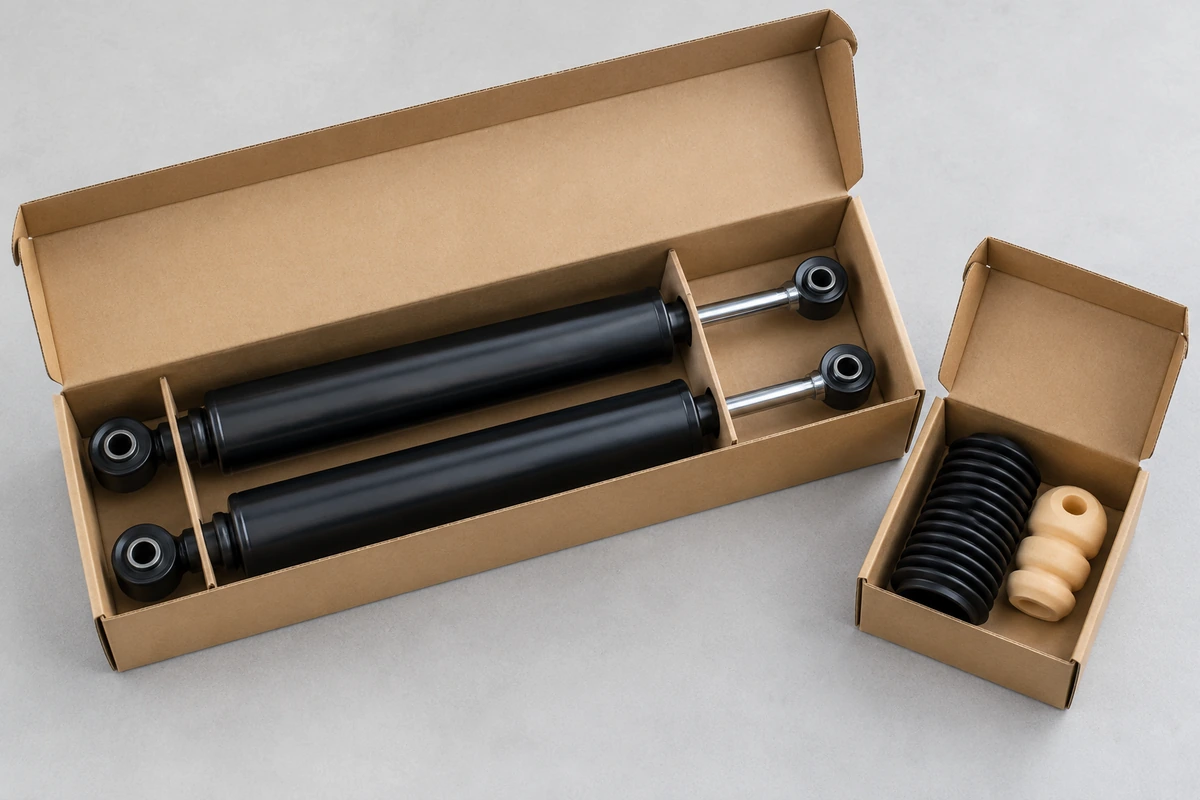
One shock twin pack and one protection kit are two order lines, not a confirmed count of two shocks and two accessory sets. Before consolidating the already-approved goods, expand each commercial unit into its actual supplied contents. Allocating accessories alongside a shock twin pack depends on those separate definitions.
The decision is whether the packing plan assigns the purchased accessories to the intended destination in the agreed quantities. It does not prescribe replacement in pairs, select suspension parts or declare the shipment a complete axle repair.
Let each supplied product define its own unit
ZF’s passenger-car and light-commercial-vehicle shock page, checked on 14 October 2026, describes TRW shocks offered in twin packs. In a separate SACHS section, it describes service kits containing compression stops or auxiliary springs and bellows or protective tubes. These are distinct named product examples on the English portfolio page, not a statement that a TRW pair includes SACHS accessories.
The page does not establish the contents of another supplier’s bundle or a universal quantity within every protection-kit reference. Ask the actual provider for each approved item’s supplied-unit definition, including any separately ordered mounts. Avoid inferring a matched combination or regional availability from the fact that product families share one manufacturer website.
For the shock line, state both commercial packs and physical shocks. For the protection-kit line, state commercial packs and the attributable accessory contents per pack. For mounts, retain the actual included or excluded scope. Keep an unresolved conversion visible rather than filling it with the number two from the shock line.
Expand the lines before grouping them by destination
A destination bundle is a packing group. Its contents should follow the approved order allocation rather than acquire extra membership because someone calls it an axle kit. Ask which shock pack and which accessory references belong to each destination, with quantities expressed in their own units.
If several destinations share an order, a correct grand total may still conceal an allocation gap. The provider should show what each recipient receives and what remains unallocated. Unallocated purchased stock is a different status from a confirmed shortage; an accessory excluded from the purchase is a different status again.
Do not use appearance to decide whether one protection pack serves one shock or a pair. The answer belongs to the exact supplied reference and its documented contents. Similarly, two accessory pieces might be different components of one kit rather than two complete kits. Piece count needs names and membership before it becomes useful.
Resolve the word “kit” before the final pack approval
Ask the provider to expand any ambiguous kit description. The response should identify the actual contents, quantity basis and exclusions of that approved item. A supplier’s statement that it is “enough for the job” introduces a repair-scope conclusion without resolving the purchase record.
A concise allocation worksheet should contain the shock twin-pack reference, shocks per supplied unit, protection-kit reference and contents per unit, mount scope, destination allocation and open quantity questions. This is an original commercial packing aid, not a manufacturer bill of materials or a suspension-service specification.
A packaging provider can identify a mismatch in the proposed allocation, but should not silently purchase extra items, divide a supplied unit or replace an accessory reference to make the list balance. Those changes need their own appropriate product and commercial approval.
Fictional example: one accessory line is assumed to mean a pair
Imagine a fictional order for one confirmed two-shock pack and one separately approved protection-kit reference. The packing instruction calls the combined carton a complete axle package. No one has yet recorded how many of the relevant accessory sets the protection-kit unit contains. These quantities and descriptions are invented for this example.
The coordinator assumes that “one kit” means a pair and allocates one accessory set beside each shock on the packing list. That is an unsupported conversion. The buyer asks the provider for the actual contents of the approved accessory reference before accepting the allocation.
Suppose the answer confirms that the purchased protection unit contains only one of the accessory sets the packing list assumed. The buyer records the actual purchased contents and the difference from the proposed allocation. It does not mark the supplier short merely because the buyer’s packing list invented a second set. Any request for additional goods requires a separate decision.
Alternatively, the provider might substantiate that the actual protection unit contains both allocated sets. That resolves this conversion, but says nothing about separately excluded mounts or whether all parts needed for a repair have been purchased. The bundle can be described accurately without making that broader claim.
Keep changes in units visible through the handover
The accepted record should name the final product references, the conversion from each commercial unit to supplied contents, and the destination grouping. If the provider substitutes two single-shock cartons for one twin pack, or changes an accessory-pack size, review the affected quantities and associations even when the broad product description remains unchanged.
Equally, a transport-carton change alone need not alter the agreed commercial units. Follow the actual proposal instead of counting every physical container as a new sold kit. The purchasing outcome is a supported allocation of what was bought, with shortages, exclusions and extra requests distinguished. Condition, performance, fit and repair completeness remain separate decisions.
Bring the actual proposal into the sourcing request
See Suspension and steering for category context and the supplier-check guide for the earlier supplier review. The manufacturer example above does not establish affiliation, a branded-goods offer or another supplier’s capability. Independent aftermarket or unbranded proposals need their own attributable evidence.
An Autoparts sourcing request can identify the approved product and the specific packing change still awaiting an answer. The form accepts an 8–1200-character description and up to five PNG, JPEG, WebP or GIF images, at most 10 MiB each and 20 MiB total. It does not accept PDF, CAD or ZIP files; arrange other technical files through a separately agreed, authorized exchange. Buying coordination and supplier negotiation do not establish an owned factory or laboratory, specialist packing services or engineering approval.
Frequently asked questions
Does a shock twin pack include two protection kits?
That cannot be inferred from the shock-pack description. Confirm the actual supplied contents of the approved shock reference and each separately ordered accessory reference. The manufacturer example distinguishes twin-pack shocks from complementary service kits; it does not establish a bundled accessory quantity for the actual offer.
How should “one protection kit” be counted?
Record one commercial kit unit, then expand it into the specific contents and quantities established for that reference. Do not assume it contains one set per shock or a pair of every component. Until the provider confirms the conversion, leave the planned accessory allocation unresolved.
Is a missing second accessory set automatically a supplier shortage?
Only if the accepted supply scope actually required it. If the buyer’s packing plan assumed that a one-set accessory pack contained a pair, the discrepancy is between the plan and the purchased contents. Record the correct scope and obtain approval for any additional purchase rather than inventing a shortage claim.
Can the combined carton be labelled a complete axle-repair kit?
A packing group alone does not establish repair completeness. Use a description that matches the approved purchased contents and explicit exclusions. Mounts, other components, application suitability and technical repair decisions need their own evidence and authorization; they do not follow from allocating two shocks and the ordered accessories.
Sources
Discuss a sourcing request related to this article.Separate shock twin packs from protection-kit counts