
Record Radiator Neck and Mounting Damage Before Any Fit Trial
Record radiator neck and mounting-lug concerns separately from core appearance, using authorized interface evidence instead of hose or vehicle fit trials.
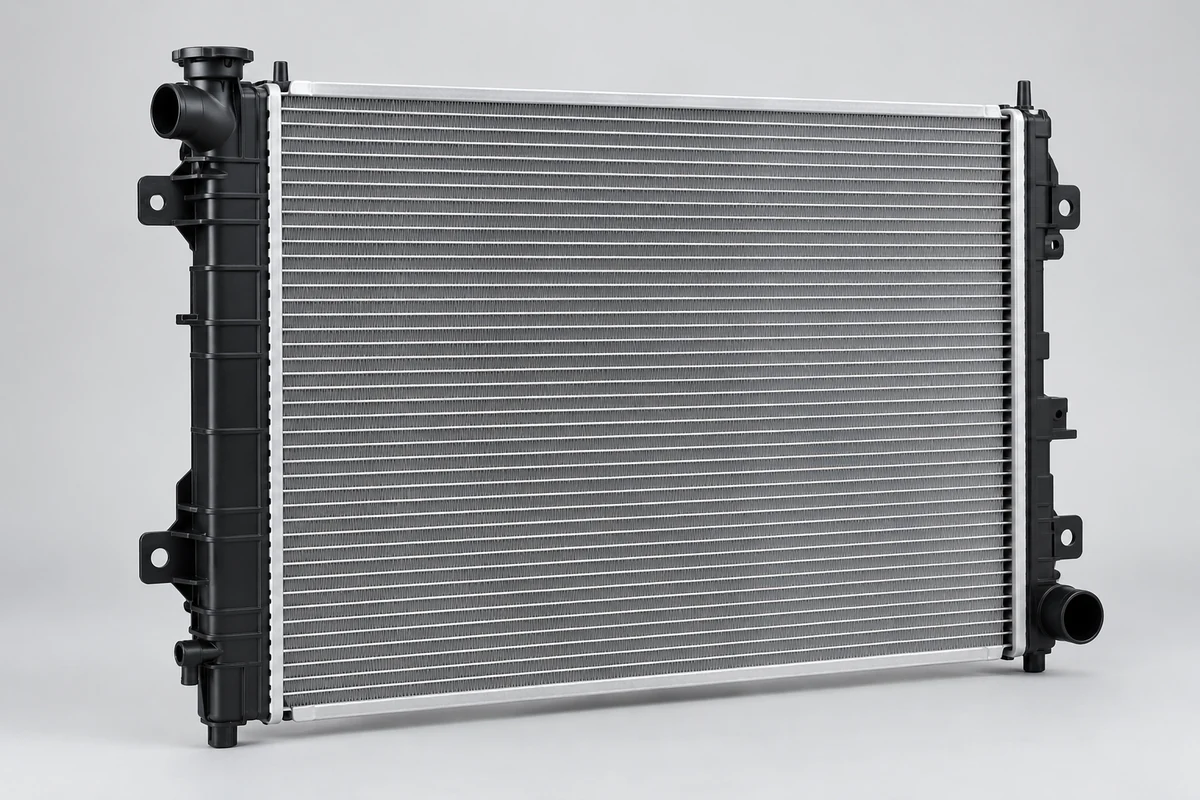
An intact-looking radiator core does not cancel a cracked mounting lug or an uncertain neck shape. At receipt, keep the protruding connection and support interfaces in their own record. Do not force on a hose or offer the radiator to a vehicle to decide whether a delivered discrepancy matters.
The buyer’s question is whether those interfaces match the already approved radiator and what evidence is needed for any visible departure. It is not a cooling-capacity comparison, a repair plan or an installation trial.
Fix the layout reference before comparing the neck
DENSO’s radiator overview explains the heat-transfer role and distinguishes down-flow from cross-flow layouts. This is background for retaining the actual assembly identity; it does not establish interchangeability between similar rectangular cores. DENSO cooling-radiator overview
Use the approved product reference and its connection and mounting layout. A radiator with a similar core outline may place a neck or support differently. Where the supplied identity and layout disagree, keep the conflict visible instead of deciding which record to trust from appearance alone.
Choose comparison views that make the relevant feature legible. An oblique image of a round opening can look oval; that is not the same evidence as a controlled dimensional result. State “opening appears oval in this view” if that is all that can be supported. Do not scale a marketplace image to create a precise neck dimension or tolerance.
Separate an observed crack from an appearance concern
A clearly visible crack-like separation at a lug should be identified by its exact location and original image. An uncertain line stays uncertain. The receiver should not flex the lug, bend the neck or insert a tool to see whether the feature opens up.
A neck-shape concern and a mounting-lug concern can coexist on one unit but require different responses. The neck question may need a controlled comparison with the authorized interface drawing. The lug question may need a condition assessment of the visible damage. A response about one does not settle the other.
Record surrounding tank and core context so the reviewer can locate the protruding feature. Do not let a broad “core fine” statement overwrite the interface fields. Equally, do not infer a damaged core merely because a lug is cracked. Each conclusion needs its own evidence and scope.
Keep mounting terminology tied to the approved drawing or product description. Avoid inventing a new hole number or datum from a cropped photograph. If the supplier and buyer call the same support by different names, reconcile the labels on an annotated copy while retaining the original image.
A fit trial can conceal the supplied-state issue
A suggestion to fit a hose, tighten a support or try the radiator in the vehicle changes the activity from receiving evidence to installation. It can also change the observed neck or lug. The correct response is to obtain the relevant drawing and a qualified disposition, not see whether force makes the part fit.
If a controlled measurement is required, ask the responsible reviewer to specify the feature, reference, method, criterion and competent provider. This article does not supply those instructions. A measurement without an agreed feature definition can produce a number while leaving the comparison unresolved.
Retain packing-restraint contact where it is documented. A protruding neck beside a compressed insert is useful context, not automatic proof of transit causation. Do not reposition the part against damaged packing to stage a more persuasive photograph.
A neck-and-mount interface worksheet
This original worksheet separates identity, visible damage and the need for controlled evidence.
| Record | What to retain | Next question |
|---|---|---|
| Radiator identity | Approved reference, revision and supplied marking | Does the layout correspond to this reference? |
| Port/neck view | Specific neck, orientation and visible concern | Is the shape documented or still only apparent? |
| Mounting feature | Drawing label and crack/line observation | What assessment addresses that support? |
| Core/tank context | Whole-unit view linked to the detail | Which areas are actually covered? |
| Packing restraint | Original contact relationship where known | Does it establish context without claiming cause? |
| Drawing discrepancy | Relevant controlled feature and missing evidence | Who owns the comparison and disposition? |
Do not use one “fits” column to replace these fields. That would collapse an identity conflict, an observed crack and an unmeasured shape concern into a conclusion unsupported by the available evidence.
Fictional counterexample: a sound-looking core is not the whole radiator
A fictional radiator R-9 has no visible core anomaly in its available front view. One mounting lug has a visible crack, and a neck opening appears oval in an angled photo. Its supplier says the core is undamaged and suggests pushing a hose onto the neck. All details and identifiers are invented.
The buyer records three limited observations: the front core view, the lug crack and the unresolved neck appearance. R-9 remains held for the relevant interface questions. The hose trial is not performed, and the core statement is not treated as approval of the neck or mount.
Suppose the supplier supplies a correct drawing but only for the neck. That creates a better basis for the neck comparison; it does not address the cracked lug. If a competent assessment later finds that the angled image misrepresented the neck, the lug concern still remains. The buyer can close one issue without declaring the entire assembly accepted.
If replacement or return is proposed, document the exact unit and agreed handling responsibility. A replacement radiator needs its own arrival review even if its core looks identical to R-9’s.
Require an interface-specific outcome
Ask for the actual radiator reference, the requirement relevant to each affected interface and a response stating what evidence supports the proposed decision. Matching dimensions, if established, still do not prove cooling capacity or whole-assembly suitability. A supplier’s commercial concession does not authorize reshaping, coolant work or a vehicle fit experiment.
Keep the buying request tied to the actual part
For category context, see Cooling parts; the supplier-check guide covers the earlier supplier review. Independent aftermarket or unbranded sourcing and authorized drawing-based proposals require their own product evidence. The manufacturer cited here is a documentary example, not an affiliation, branded-goods offer or endorsement of another supplier.
Start an Autoparts sourcing request with the exact received reference and the unresolved question. The form accepts an 8–1200-character description and up to five PNG, JPEG, WebP or GIF images, at most 10 MiB each and 20 MiB total. PDF, CAD and ZIP uploads are not supported. Arrange other technical files through a separately agreed, authorized exchange. Buying coordination and supplier negotiation do not establish an owned laboratory, an inspection service, engineering approval or a guaranteed remedy.
Frequently asked questions
Can a good-looking radiator core clear damaged mounting points?
No. Core appearance and mounting-interface condition are different observations. Record each affected neck or lug separately and obtain a disposition that addresses it. A broad core statement cannot erase an independent support concern.
Does an oval-looking neck photograph prove deformation?
Not by itself. Viewpoint can affect apparent shape, so preserve the image and state the uncertainty. A responsible reviewer can determine whether a controlled comparison is needed against the applicable drawing; do not invent dimensions from the photograph.
Should a hose be pushed on to check the neck?
No fit trial belongs in this receiving record. It can alter the supplied condition and does not establish the correct technical acceptance. Ask for the interface evidence and product-specific disposition instead of using force to resolve uncertainty.
What should be requested if a measurement is needed?
Ask the responsible technical owner to define the actual feature, authoritative reference, competent assessment and applicable criterion. This article intentionally provides no tolerance or measurement procedure. A number without a shared feature definition may not resolve the discrepancy.
Sources
Discuss a sourcing request related to this article.Record Radiator Neck and Mounting Damage Before Any Fit Trial