
Keep Gas-Strut Rod Damage Separate from Tube Marks
Record gas-strut rod, tube and seal-region concerns separately, preserving adhesive and finish evidence without cleaning, compression or improvised force checks.
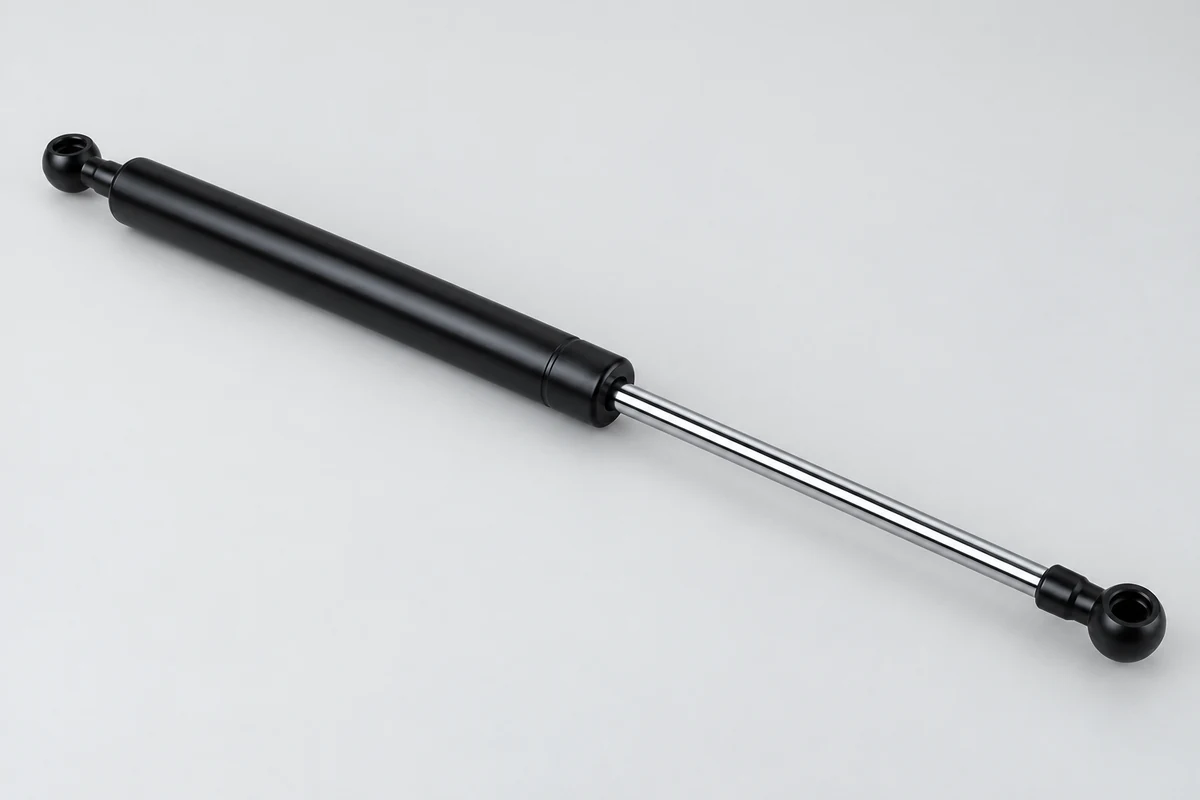
A mark on a gas strut needs a location before it needs a label such as cosmetic. Record whether the concern is on the exposed piston rod, the pressure tube, the seal region or an end fitting. Adhesive on a rod and a scratch in the tube’s painted finish should not become one undifferentiated “surface mark” entry.
This review concerns the arrival condition of an already specified, unused strut. It does not select force, prove support capacity or authorize compression. Where damage makes handling uncertain, leave movement to the personnel responsible for safe handling under the applicable instructions.
Rod and tube observations answer different questions
Stabilus links gas-spring function to the piston-rod surface and sealing system. Its handling guidance warns against rod contamination and paint, impacts and modifications, and its transport guidance addresses contamination from tape or thin packaging film. These statements explain why the location matters; they do not supply an acceptable scratch depth for an unknown strut. Stabilus gas-spring handling guidance
Identify the visible rod and the larger tube in the record without assuming that a mark can be moved from one category to another because both surfaces look metallic. Use the actual assembly reference where a protective cover or different construction obscures the distinction. If the relevant area cannot be identified confidently, write that uncertainty rather than inventing a component name.
The seal-region observation should state only what is accessible. A mark near the rod entry is not proof of damaged internal seals. It is also not cleared by the absence of visible leakage. The responsible technical reviewer needs the location and evidence limits before deciding how to assess it.
Tape and film are part of the product-condition question
If adhesive or packaging film is visibly contacting the rod, record its location before somebody peels or scrapes it away. Distinguish a loose wrapper around the tube from material actually on the rod. A photograph should make that distinction without requiring the receiver to draw the rod out or compress the strut.
Do not clean, lubricate or touch up the part as a way to obtain a more presentable receiving image. Removing adhesive may alter the surface evidence, while painting can conceal the original mark. The seller’s suggestion to tidy it first should remain a proposed action for review rather than an automatic warehouse instruction.
Preserve any known packing contact relationship. A tube mark beside a carton restraint may be useful context, but it does not alone establish who caused it or when. Avoid asserting a carrier impact merely because the outer carton is also marked.
A tube scratch is not automatically harmless
Separating the tube from the rod prevents misplaced conclusions in both directions. A tube finish concern should not be described as rod damage. But calling it “only on the tube” does not establish that it is acceptable, especially where the depth, nature or underlying condition is unknown.
Compare the received condition against the agreed finish and product requirements. If the criterion is missing, ask for product-specific disposition rather than creating a universal scratch allowance. A competent response may need more evidence than the accessible view provides. That is an evidence gap, not a reason to press or cycle the strut until someone feels reassured.
End fittings and supplied identifiers should retain their own entries where a visible anomaly exists. An undamaged-looking fitting does not settle the rod question, and the correct printed force designation does not prove actual force or condition. No improvised actuation or gas-release procedure belongs in this receiving record.
A location-led strut worksheet
This original editorial aid records distinct surfaces without prescribing mechanical testing.
| Record | Evidence to retain | Decision not supplied by the worksheet |
|---|---|---|
| Exact strut | Approved reference, delivered marking and unit link | Application suitability or force verification |
| Exposed rod | Accessible mark or material, location and original view | Surface acceptability under product-specific criteria |
| Pressure tube | Finish concern or other visible feature | Whether the concern is merely cosmetic |
| Seal region | What is visible and what is concealed | Internal seal condition |
| Tape/film relationship | Where packaging contacts the part | Whether removal or treatment is appropriate |
| Unaltered outcome | Handling history, reviewer and scoped response | Permission to actuate, repair or modify |
Use “not assessed” where a region cannot be safely viewed. A full-length photograph does not guarantee full-surface coverage. Do not put an unobserved reverse side into the no-damage category just to complete a count.
Fictional counterexample: two marks, no force demonstration
A fictional delivery contains struts G-A and G-B. G-A has visible adhesive on its exposed rod. G-B has a scratch in the painted tube surface. The seller suggests scraping G-A clean and compressing both to demonstrate that they work. All identifiers and events are invented.
The buyer keeps the two observations distinct. G-A’s rod-contact concern is not reduced to a packaging issue, and G-B’s tube mark is not labelled harmless without its applicable criterion. Neither unit is actuated. The response request identifies both locations and asks the responsible provider for product-specific disposition in the unchanged supplied state.
Suppose a qualified response later addresses G-B’s finish under the agreed requirement but says nothing about G-A. The record can close that limited appearance question for G-B if the authorized owner accepts the basis, while G-A remains unresolved. It must not turn into a shared functional pass for both struts.
If a replacement is proposed, its identity and supplied condition need their own record. Removing the original adhesive or applying new paint would not establish that the original concern never existed.
Keep the remedy separate from mechanical proof
Ask for a clear response identifying the part and surface covered, the evidence considered and any further competent assessment needed. A claim that the strut moves is not an answer about its arrival condition. Commercial terms, safe handling and technical acceptance remain distinct responsibilities.
Keep the buying request tied to the actual part
For category context, see Body parts; the supplier-check guide covers the earlier supplier review. Independent aftermarket or unbranded sourcing and authorized drawing-based proposals require their own product evidence. The manufacturer cited here is a documentary example, not an affiliation, branded-goods offer or endorsement of another supplier.
Start an Autoparts sourcing request with the exact received reference and the unresolved question. The form accepts an 8–1200-character description and up to five PNG, JPEG, WebP or GIF images, at most 10 MiB each and 20 MiB total. PDF, CAD and ZIP uploads are not supported. Arrange other technical files through a separately agreed, authorized exchange. Buying coordination and supplier negotiation do not establish an owned laboratory, an inspection service, engineering approval or a guaranteed remedy.
Frequently asked questions
Is a scratch on the tube automatically less important than a rod mark?
Location changes the question, but it does not provide an automatic pass. Record tube and rod concerns separately and use the actual product requirements. Unknown depth or condition remains unresolved rather than becoming cosmetic by default.
Should adhesive be removed from the rod before reporting it?
Preserve the original accessible evidence and seek product-specific disposition. Scraping or cleaning changes the surface condition being discussed. Stabilus specifically warns about rod contamination and packaging-related contamination; that is not a cleaning instruction.
Can compressing the strut demonstrate that an arrival mark is harmless?
No improvised compression or force demonstration belongs in this receiving process. Apparent motion does not classify the surface concern or prove the required force and application performance. An appropriate technical owner must define any further assessment.
What if the seal area cannot be seen?
State that it was not assessed and keep the available rod and tube observations. Do not actuate or dismantle the part to expose it. A reviewer can decide the next safe, authorized step without a fabricated complete inspection record.
Sources
Discuss a sourcing request related to this article.Keep Gas-Strut Rod Damage Separate from Tube Marks