
Control Arm Handover: Headlight-Leveling Dependency
Carry any application-specific headlight-leveling dependency across a control-arm replacement, with a named second-task owner and separate evidence.
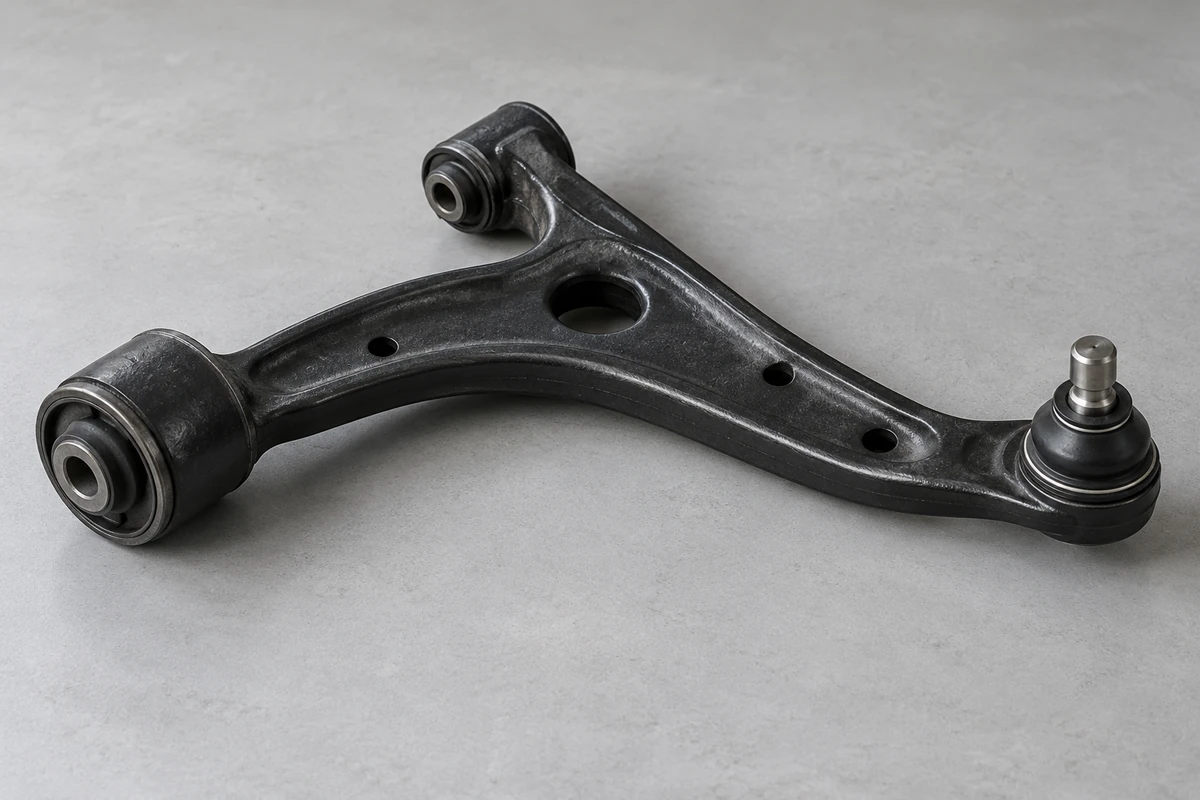
A control-arm replacement may cross a service boundary that is invisible in the parts order. For a vehicle with the relevant self-leveling headlight equipment, ask the qualified provider whether the actual work creates a separate lighting-system task. Keep that dependency visible when suspension work changes hands.
The buyer is not deciding how the sensor works or whether every arm replacement needs a reset. This handover starts with an established arm application and addresses responsibility for a possible second-system task. Arm contents, structural validation and physical adjustment remain outside it.
The source example is equipment-dependent
Delphi's diagnostic-jobs article gives an example linking control-arm replacement on a vehicle equipped with self-leveling headlights to a separate sensor task. Checked on 14 October 2026, it prompts an applicability question; it does not establish a current requirement for every vehicle or arm position. Delphi diagnostic-job examples
Ask the actual service provider to identify the installed system and applicable current instruction. A model family can contain different equipment, and a purchasing description saying front arm cannot supply the missing service relationship. Do not derive a task from the presence of a familiar-looking attachment in a photograph.
Preserve the link between the two scopes
Start with the exact arm and job reference already authorized. Add the provider's answer about the headlight-system dependency, including the evidence it used and which part of the work the answer covers. Keep a general vehicle-equipment statement separate from a conclusion about this replacement event.
If the provider confirms that the task applies, record how it appears in the accepted service scope. If it confirms non-applicability, retain the basis instead of leaving an unexplained blank. If the relationship remains uncertain, identify who will resolve it; do not convert uncertainty into a mandatory reset or a completed checkbox.
A suspension-completion record may legitimately describe only suspension work. Ask whether its author intended to cover the lighting dependency before treating the phrase job complete as a whole-vehicle conclusion. Narrow records can be useful when their boundaries are explicit.
Assign the second task before it disappears between trades
The same workshop may own both tasks, or a different provider may own the lighting-related scope. In either case, name the accepted responsibility and the record expected. An informal instruction to tell the electrician later is not an accepted assignment.
Where another provider is proposed, ask what information it needs from the suspension job and who supplies that information. Obtain its actual scope confirmation and terms. Do not presume availability, equipment coverage or free additional work simply because it offers general diagnostic services.
Keep changed parts or changed job scope visible. If the actual arm position or vehicle equipment differs from the original enquiry, have the responsible provider reconsider the dependency. An earlier answer for another configuration should remain part of the history, not the authority for the changed job.
Cross-system handover worksheet
| Field | Entry to obtain | Gap it reveals |
|---|---|---|
| Arm and job | Exact established application, position and replacement reference | Is the answer tied to this work? |
| Lighting equipment | Provider-confirmed system identity | Is relevant equipment actually established? |
| Dependency | Current instruction and qualified applicability answer | Required, not applicable or still uncertain? |
| Suspension record | Stated completion scope and exclusions | Does complete mean suspension only? |
| Second-task owner | Accepted responsibility and information needed | Has the handover crossed the trade boundary? |
| Remaining task | Attributable result or explicit exception | Who owns the unresolved decision? |
This is a responsibility map, not a sensor-adjustment guide. It specifies no reset sequence, beam setting, road test or technical pass criterion.
Fictional case: the suspension job is signed, lighting is unnamed
In a fictional job for arm A, Workshop S supplies a completed suspension record. An earlier qualified applicability note identifies a lighting-system dependency for that exact equipped vehicle. The final record contains no reference to that note, and Workshop L has only been suggested as a possible second provider.
The buyer asks S whether its completion statement covers the identified dependency. It also seeks L's actual scope proposal rather than writing L into the file as committed. The task remains open even though the purchased arm and suspension work are accounted for. Nothing in the example establishes a fault or an unsafe beam condition.
Suppose S confirms that its record intentionally excludes the lighting task. That is a useful boundary, not necessarily a service failure. The buyer can obtain and authorize the separate scope under the actual arrangement. Once L provides a result, it should be tied to the same vehicle and replacement event, with qualified review preserved.
Close the dependency rather than widening the signature
The final packet should show how the arm replacement and any required lighting task connect, and which provider owns each conclusion. Do not ask a parts supplier to certify a completed vehicle job because it supplied the arm. Documentary closure means the applicable relationship and responsibilities are traceable; it does not provide a technical release.
Keep the purchasing enquiry focused
For category context, see Suspension parts. In an Autoparts sourcing request, identify the actual part and the unresolved handover question. The form supports an 8–1200-character description or a supported marketplace HTTPS link, and up to five PNG, JPEG, WebP or GIF images, limited to 10 MiB each and 20 MiB combined. PDF, CAD and ZIP files need a separately agreed, authorized exchange.
Independent aftermarket or unbranded buying coordination and supplier negotiation do not establish service-provider capability, fitment, engineering approval or a ready-for-use vehicle. Named manufacturers above are documentary examples, with no affiliation or branded-goods offer implied.
Frequently asked questions
Does replacing any control arm require a headlight reset?
No universal requirement is established here. The qualified provider must check the actual vehicle equipment, affected work and current instruction. Keep a supported non-applicability answer distinct from a missing answer.
Can a suspension job marked complete cover the lighting task automatically?
Only the attributable scope of that record can establish what its author meant. Ask whether the identified dependency is included. A suspension-only completion statement should not be expanded into a lighting-system result by the coordinator.
What if a second workshop has been suggested but not booked?
Record it as a proposed provider, not an accepted owner. Obtain its actual scope, coverage and terms and identify how it will receive the relevant job information. A referral alone does not close the assignment gap.
Does an installed joint or complete arm assembly settle this handover?
Those statements concern the delivered arm’s contents or supplied state. The headlight-leveling dependency is a separate vehicle-service question. Neither assembly completeness nor a supplier photograph establishes its applicability or completion.
Sources
Discuss a sourcing request related to this article.Control Arm Handover: Headlight-Leveling Dependency