
Retain the supplied cover on a PTFE seal
A supplied PTFE seal cover can support the sensitive lip’s geometry. Review a proposal to remove it for a shallower package as a change to the supplied protected state.
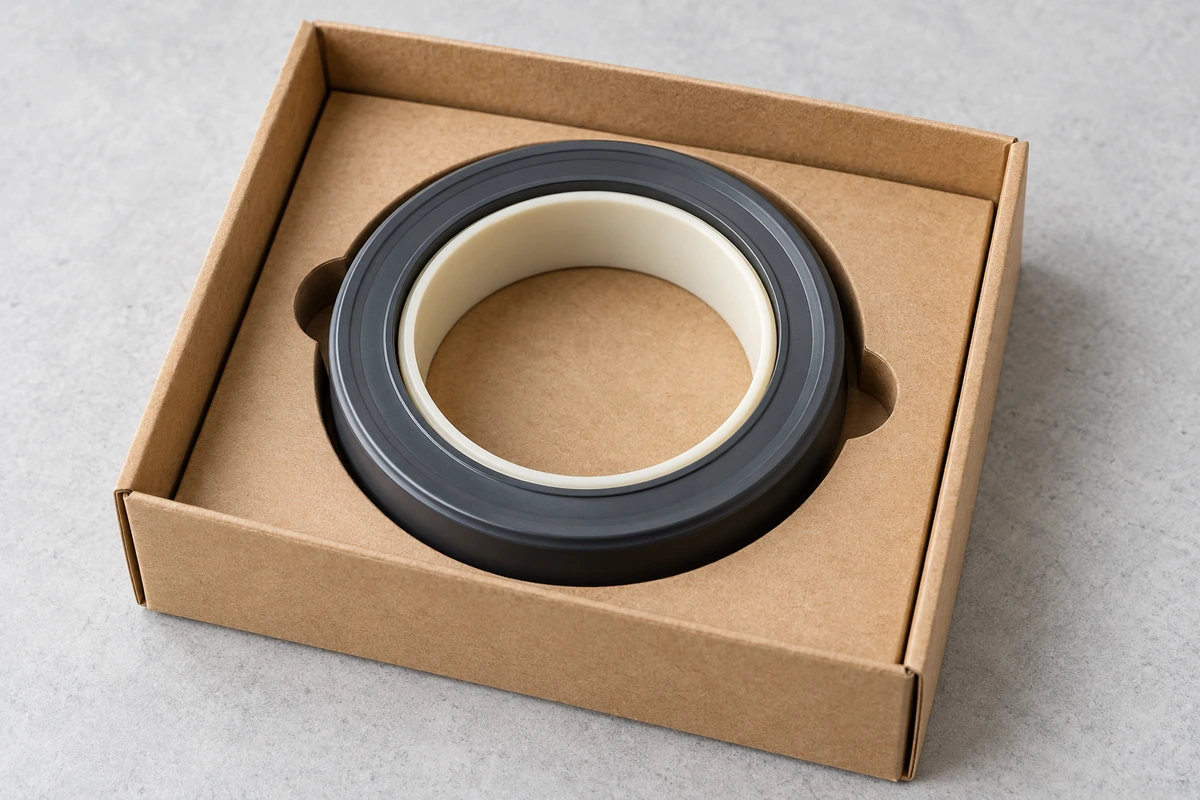
If a PTFE seal arrives with a supplied protective cover, do not classify that cover as dispensable presentation material simply because it is plastic. A proposal to remove it for a shallower insert can change the state in which the sealing lip is supported. Resolve that product-specific boundary before approving the consolidation plan.
The buying question is whether the proposed PTFE seal packaging retains the cover in the maker-described supplied state. It is not how to remove, refit or install the cover, and it does not establish that every PTFE seal must have one.
Identify the role of this seal’s supplied cover
Elring’s TSI 09/11 guidance on PTFE oil seals describes a plastic cover commonly supplied to protect the sensitive sealing lip and maintain its geometry. It reserves removal for assembly and notes that lip disturbance may have effects that are not visibly obvious. The dated September 2011 source was checked at its current URL on 14 October 2026; page 2 also discusses commercial-vehicle applications.
Use that example to ask for the current instruction applicable to the actual seal. It does not establish that an unknown seal uses the same cover or that a 2011 document supersedes newer product-specific information. Record the exact seal reference, the supplied cover’s documented purpose and any unresolved applicability question.
The source distinguishes a functional role for the cover from ordinary exterior presentation. That distinction is why the buyer should ask about the cover itself when the proposal says only “reduce packaging.”
Describe the changed state rather than specifying an insert
Ask whether the proposed packing revision changes only the outer carton or also requires removal, replacement or disturbance of the supplied cover. The provider’s proposal should name the affected layer. A smaller outer box and an uncovered sealing lip are materially different supplied states, even if both reduce package volume.
If a shallower insert only accommodates the seal after cover removal, record that dependency plainly. The provider can then propose an arrangement that retains the applicable protected state or refer the change to the responsible product authority. Do not turn the buyer’s dimensional preference into permission to alter the seal’s protection.
This review does not specify insert dimensions, contact points, cover material or an alternative lip support. Those are physical packaging and product decisions for the appropriately qualified provider. Purchasing needs a supported proposal and a clear decision owner rather than an improvised design.
Keep appearance separate from a geometry conclusion
A packing photograph can show that a cover is present or that the proposed layout depicts an uncovered seal. It cannot by itself establish unchanged lip geometry after an unsupported disturbance. Avoid asking for a cleaner photograph as though it would settle the technical history.
Record what is known: the maker-described supplied state, the proposed change, whether that change has already occurred, and the provider’s exact response. If the cover history is unknown, say so. Do not call a unit undisturbed merely because someone has placed a cover beside it or because the lip looks regular in one view.
A seal legitimately supplied without a cover is a different question. Ask for the applicable product-specific supplied-state evidence. Absence alone should not be labelled a defect by importing requirements from another seal. The purpose is to preserve the actual approved product condition, not impose a universal accessory list.
Fictional example: a shallower insert hides the unresolved change
Imagine a fictional order for an approved seal supplied with a cover identified by its provider as protecting the lip’s geometry. The proposed consolidation insert is too shallow for that supplied configuration. The packer removes the cover in a mockup and presents a photograph in which the seal looks unchanged. These events and the product configuration are illustrative, not a real delivery.
The photograph answers the layout question for an uncovered seal; it does not answer whether removal was permitted or whether the required supplied state is preserved. The buyer keeps that proposal unapproved and requests a provider response tied to the actual seal instruction.
If the change has already occurred, the record should identify the affected units and their known history. It should ask the responsible provider for a disposition rather than instruct anyone to press the cover back on. Reinstating a visible accessory is not evidence that an earlier disturbance has been reversed.
Suppose a later packing drawing shows a deeper arrangement with the cover retained. That can support review of the future packing plan. It does not retroactively resolve the already altered mockup unit. Keep prospective approval and the existing unit’s disposition separate.
Freeze a narrow supplied-state decision
The final record should identify the exact seal, applicable cover instruction, supported supplied state, accepted packing revision and any altered or uncertain units awaiting disposition. A provider’s approval for one reference should not extend automatically to a visually similar seal.
The completed purchasing record means that the packing proposal respects the supported cover boundary. It does not certify sealing performance or provide pressing, lubrication, installation, recovery or testing advice. A commercial allowance or a revised insert cannot substitute for the responsible product-specific decision.
Bring the actual proposal into the sourcing request
See Engine parts for category context and the supplier-check guide for the earlier supplier review. The manufacturer example above does not establish affiliation, a branded-goods offer or another supplier’s capability. Independent aftermarket or unbranded proposals need their own attributable evidence.
An Autoparts sourcing request can identify the approved product and the specific packing change still awaiting an answer. The form accepts an 8–1200-character description and up to five PNG, JPEG, WebP or GIF images, at most 10 MiB each and 20 MiB total. It does not accept PDF, CAD or ZIP files; arrange other technical files through a separately agreed, authorized exchange. Buying coordination and supplier negotiation do not establish an owned factory or laboratory, specialist packing services or engineering approval.
Frequently asked questions
Is a PTFE seal’s plastic cover just shipping material?
It may have a product-specific role in protecting and supporting the sealing lip. The cited Elring guidance describes that role for its covered context, but the actual seal needs its own applicable instruction. Identify the purpose before approving any proposal that treats the cover as removable presentation packaging.
Does a normal-looking lip prove that early cover removal caused no change?
No. An appearance record does not establish the lip’s geometry or resolve the history of an unsupported disturbance. Record the affected unit and what is known, then ask the responsible provider for a product-specific disposition. This review does not supply a visual pass criterion or a functional test.
Should every PTFE seal be rejected if no cover is visible?
No universal cover requirement follows from the dated source example. A seal may have a different supported supplied configuration. Obtain the actual product instruction and provider evidence before classifying absence as a discrepancy, and retain an unresolved applicability question where that evidence is unavailable.
Can putting the cover back on close a packing discrepancy?
This article provides no cover-refitting or recovery procedure. A restored appearance alone cannot establish that the earlier supplied state has been recovered. Ask the responsible product provider to determine the affected unit’s disposition, and review any future packing proposal separately from that existing unit.
Sources
Discuss a sourcing request related to this article.Retain the supplied cover on a PTFE seal