
Wheel Bearing Kits: Review Encoder Contact Before Repacking
Check how wheel-bearing kit accessories interact with an encoder-bearing subpack before approving display changes, contact or magnetic accessory placement.
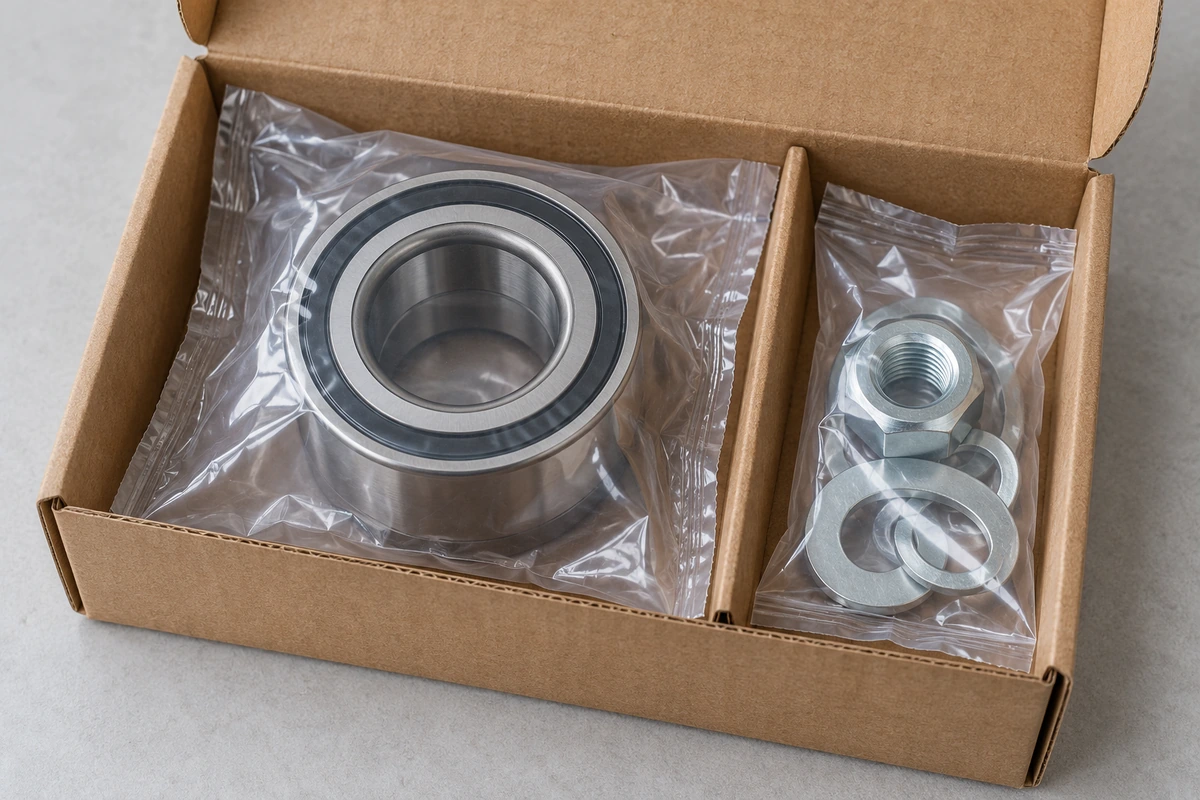
An approved wheel-bearing kit can contain the correct accessories while its proposed presentation creates an unanswered encoder-protection question. Review what the accessories would contact, what protection would be changed and whether any included magnetic item has been addressed by the responsible provider. An accurate outer-box count cannot answer those questions.
This starts with an already approved bearing and accessory list. It concerns the relationship created by the proposed packing arrangement. It does not identify an encoder by experimentation, set magnetic clearance distances, select a bearing or provide a fitting procedure.
Use the encoder-specific source narrowly
The explicit encoder subsection of NSK Europe’s wheel-bearing page advises retaining protective packaging until fitting and avoiding pressure, magnets and dirt at the encoder surface. The page was checked on 14 October 2026. Its introductory sentence describes a bearing without an encoder, conflicting with the page heading and later subsection; only the explicit encoder passage is used here. NSK encoder-protection subsection, 4:40
That limitation matters when a general webpage is forwarded as proof of a specific packing proposal. Ask the actual bearing provider to identify the applicable requirements for the purchased item. Neither this source nor a picture of a closed box establishes a safe distance from every magnetic accessory or validates a replacement enclosure.
Describe interactions, not just positions in a photograph
The packing proposal should identify the bearing’s existing protected unit and each accessory group. Then ask what changes at their interface. Does a presentation request remove a protective layer? Would an accessory become adjacent to a newly exposed surface? Does the proposal include a magnetic item whose compatibility has not been addressed?
A list saying bearing, nut and accessories leaves those interactions invisible. A layout can show intended positions, but its meaning depends on the described package state. The same drawn circle can represent a closed bearing subpack or a bare bearing; the reviewer should not infer which from a stylized rendering.
Keep a known magnetic accessory distinct from an ordinary metal component. Material appearance alone does not establish magnetism, and this article supplies no test to classify it. Record known product information and refer uncertain accessory characteristics to the provider. The buyer’s role is to expose the unanswered relationship, not to certify magnetic compatibility.
Resolve contradictory evidence requests
A request to preserve the bearing’s existing protective arrangement may conflict with a request for a product photograph showing its concealed face. Identify that conflict before approving the packing work. Ask for existing attributable records or a provider-defined evidence route rather than leaving an ordinary packer to choose which instruction to follow.
Likewise, the absence of an exposed-face photograph does not prove that the bearing is unidentified. Accessible package references and provider records may establish its identity within the agreed evidence scope. Keep identity, protection and technical condition as separate questions so that one missing image does not silently trigger a physical change.
An intact subpack can document that a particular boundary is retained. It does not, by itself, prove magnetic shielding, freedom from previous exposure or acceptable internal condition. A proposed arrangement containing a magnetic accessory still needs an applicable answer even when the bearing remains boxed.
Record the contact question for the exact proposal
Use this editorial worksheet to obtain a scoped provider response. It is not a packaging design, test method or universal encoder acceptance rule.
| Field | Specific entry to obtain |
|---|---|
| Encoder-bearing identity | Approved item reference and provider-confirmed applicable requirements |
| Existing protected unit | Actual supplied enclosure and accessible identifying record |
| Accessory group | Approved identity, relevant known characteristics and separate package status |
| Proposed interaction | Contact, exposure or proximity question created by this layout |
| Evidence conflict | Any requested photograph or display feature requiring a changed protected state |
| Provider disposition | Exact proposal addressed, conditions and unresolved questions |
Do not fill the interaction column with a universal numerical distance. The record should point to the actual question and the competent owner. If the provider cannot support the proposed layout, ask for another proposal that addresses the identified restriction rather than inventing a spacer thickness or a shielding material.
Fictional example: the same contents in two presentations
Consider a fictional approved order containing an encoder-bearing kit plus a separately approved magnetic pickup accessory. The accessory is an explicit feature of this invented order, not a claim about the usual contents of a wheel-bearing kit.
Proposal A removes the bearing’s inner protection for a display layout and shows the pickup accessory against the exposed bearing face. The item count is correct, but the proposal leaves both the changed protection and the magnetic interaction unsupported. The buyer keeps this configuration unapproved and asks the bearing provider for a disposition on those exact points.
Proposal B retains the identified bearing subpack and moves the accessory into its own identified package within the proposed outer kit. This resolves the ambiguity over whether the bearing is displayed bare. It does not automatically resolve magnetic compatibility: the provider still needs to address the actual overall arrangement. The buyer should record the improvement and the remaining question separately.
Now suppose the final photo shows neither accessory location nor the inner-package references. It cannot establish which proposal was represented. Request an attributable record identifying the configuration, without converting the request into permission to open the bearing protection. The immediate outcome is documentary clarity, not a declaration that the bearing passed a functional test.
Limit release to the supported arrangement
Close the packing review only against the actual protected-unit description, accessory arrangement and provider response. A later move of an accessory or a new display requirement should reopen the affected interaction. Approval of one configuration cannot be reused for an unnamed alternative merely because the kit still contains the same pieces.
For category context, see Suspension parts and how we check an auto-parts supplier. Describe the unresolved layout in an Autoparts sourcing request. The form accepts 8–1200 characters and up to five PNG, JPEG, WebP or GIF images, with limits of 10 MiB each and 20 MiB total. PDF, CAD and ZIP files need a separately agreed, authorized exchange. Buying coordination does not establish encoder protection, supplier capability or technical approval; the named NSK example implies no affiliation or branded-goods offer.
Frequently asked questions
Does a closed bearing box solve every magnetic-accessory concern?
No. Retaining an identified subpack can preserve a stated package boundary, but it does not establish magnetic shielding or a safe arrangement with another item. Ask the responsible provider to address the actual bearing, accessory and layout. Keep any unsupported interaction open even when both packages are closed.
Can a packing photo prove that the encoder is protected?
A photo can support only the visible, attributable arrangement it shows. It cannot establish concealed contact, previous exposure or technical condition. Use the approved proposal and provider response alongside the image, and seek clarification when the image cannot be connected to a specific packing revision.
Should every metal accessory be treated as a magnet?
The record should distinguish known magnetic items from components whose relevant characteristics are unconfirmed. Appearance is insufficient for that classification. Ask the provider for the necessary product information rather than creating an improvised test or assuming that all metal parts have the same interaction with an encoder.
Why does the article qualify the NSK page?
Its introduction and explicit encoder subsection describe different bearing contexts. The article relies only on the subsection addressing encoder protection and preserves that source limitation. Applicability to the purchased bearing still requires its own provider evidence; the page is not approval of the proposed kit arrangement.
Sources
Discuss a sourcing request related to this article.Wheel Bearing Kits: Review Encoder Contact Before Repacking