
Oil Filter RFQ: Assembly, Element and Valve Scope
Separate complete spin-on filters from replacement elements, retained housings, seals and application-specific valve questions in oil filter quotes.
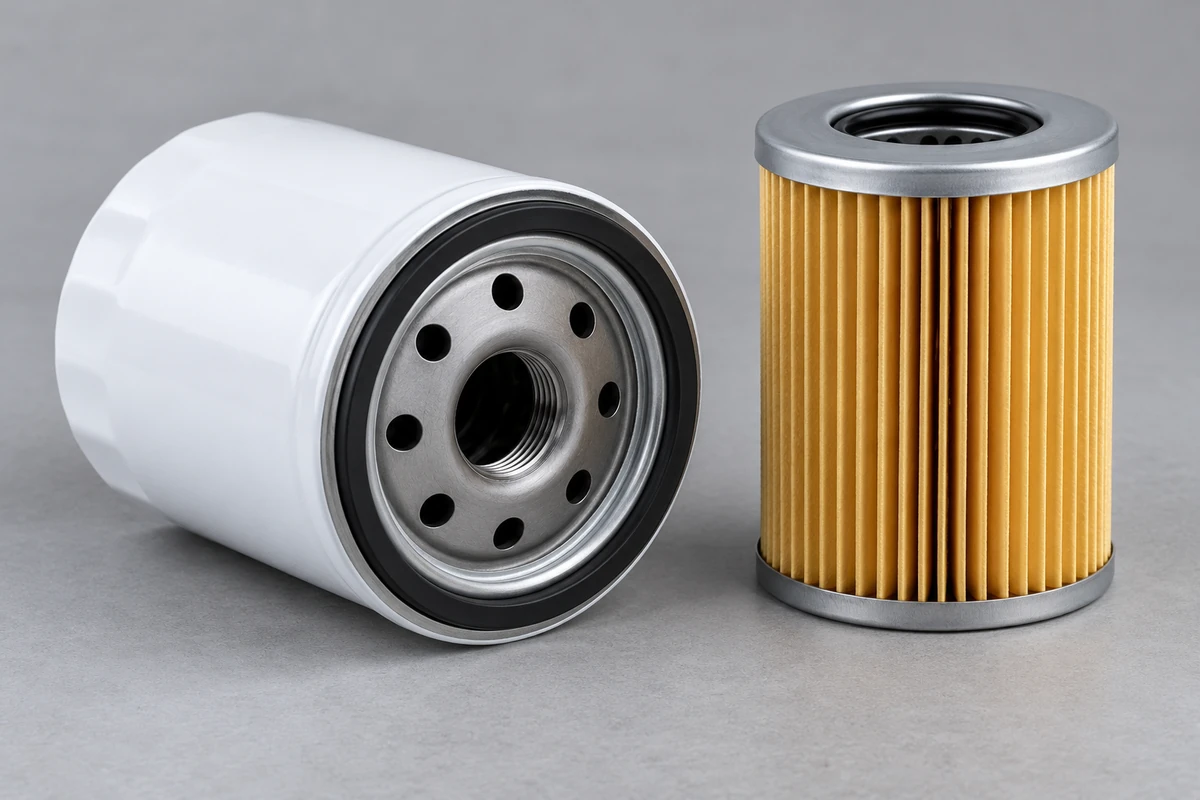
An oil filter quote needs to identify the object being supplied before anyone compares its unit price. A replaceable filter element and a complete spin-on filter are different purchase boundaries. Calling both an “oil filter” hides whether the offer assumes that a housing or other components remain outside the purchase.
Start from the already authorized application and required replacement scope. This is not a method for selecting a valve setting or deciding which vehicle components can be reused. Its purpose is to keep architecture, included parts and open technical questions attached to the quotation.
Name the architecture before listing dimensions
MANN-FILTER’s oil-filter overview distinguishes spin-on filters from filter elements and discusses return-stop and bypass functions. That supports asking architecture and valve-scope questions; it does not supply the valve arrangement, setting or dimensions for an unspecified application. MANN-FILTER oil-filter formats
An element-only offer should be labeled as such. A complete spin-on offer should identify the complete supplied product. Where an element is the intended purchase, identify the authorized retained-housing reference separately instead of assuming that any existing housing is suitable. Where a housing is to be supplied, it needs its own explicit inclusion rather than a photograph that happens to show one.
Do not resolve this distinction by looking for a similar cylindrical shape or by comparing only element height. A shape comparison cannot tell the buyer which functional parts the price includes. The required architecture comes from application-specific information, not the supplier’s cheapest stock line.
Put valve questions in the correct place
The RFQ should identify the required function and ask where that function is provided in the established arrangement. Ask for application-specific evidence identifying the relevant component and specification. If the buyer does not have that information, assign the question to the responsible technical owner; do not ask purchasing staff to invent a value.
Keep “supplied in this product,” “provided elsewhere in the approved arrangement” and “unknown” as different responses. A seller’s statement that a valve is not in the offered element does not by itself establish a defect. It also does not prove that the complete arrangement provides the required function. The architecture record must make that boundary clear.
A general manufacturer’s explanation is helpful background, but it is not evidence that every spin-on design has identical internals or that every element uses the same retained features. Avoid extracting a setting from another product, translating a missing field as not applicable, or treating an unexplained catalogue cross-reference as complete technical evidence.
Use an architecture worksheet, not a filter-size table
| Purchasing question | Required record | Open-question example |
|---|---|---|
| Which application is authorized? | Exact reference and applicable variant | Quote cites only a broad engine family |
| What is purchased? | Complete spin-on, element, housing assembly or other approved boundary | Supplier writes only “filter” |
| What remains outside the purchase? | Identified retained component assumption | Element price silently excludes required housing |
| Where are required valve functions accounted for? | Application-specific scope and evidence owner | Function location or specification unknown |
| Which seals are supplied? | Identified seals and counts against the required scope | “Seals included” without identity |
| What is the alternative? | Original requirement, offered difference and technical decision | Another architecture described as equivalent |
Use the worksheet to prepare questions, not to certify the design. If the baseline requires an element only, do not inflate it into a complete assembly without an authorized change. Conversely, a complete-assembly requirement must not shrink to the cheapest replaceable component.
Fictional comparison: a price that assumes a retained housing
A fictional buyer requests an approved complete spin-on filter for a defined application. Offer A supplies a bare replacement element and a seal, while Offer B explicitly quotes a complete spin-on unit but leaves one required valve-evidence question unanswered. No actual supplier or product acceptance is represented.
A is outside the requested architecture. The buyer does not add an estimated housing cost and call it matching, because the resulting combination has not been defined or accepted. Ask A for the required complete product or retain its response as nonmatching. B has answered the purchased-object question but still cannot pass the unresolved technical requirement merely because its package is complete.
Now consider a different, explicitly authorized element-only request. Here an element price could be the correct commercial basis, provided the actual element, seals and retained arrangement are identified. The lesson is not that more components are always better. It is that the quote must answer the required architecture rather than quietly deciding it.
Separate seals, evidence and commercial concessions
For each included seal, request its identity within the supplied assembly or application record and whether it is in the quoted package. Do not assume that a pictured collection is the contents of every variant. If a supplier proposes a different material or seal scope, record the change for technical review instead of accepting it as a packaging choice.
Once the assembly boundary is clear, request actual same-scope pricing and commercial terms. A supplier may offer an unbranded or drawing-based proposal, but it must identify its own offered architecture and evidence. Do not promise that custom manufacture, omitted seals or a different internal arrangement will deliver savings.
Close the purchasing clarification only when the object, retained assumptions and outstanding valve questions are explicit. The responsible technical reviewer still owns suitability and the required acceptance evidence. There is no buying-sheet shortcut around an unknown lubrication-system requirement.
Prepare the sourcing request
For the broader product group, see Engine parts. If the application is not established, start with the OE and application identification guide before asking for a substitute.
Use the Autoparts sourcing request to describe the required item and the particular question left open above. The form accepts a description of 8–1200 characters and up to five PNG, JPEG, WebP or GIF images, limited to 10 MiB each and 20 MiB total. It does not accept CAD, PDF or ZIP attachments. Authorized drawing images can start a discussion; arrange other technical files separately through an actually agreed, authorized exchange.
Keep requests for independent aftermarket or unbranded alternatives tied to the authorized application or drawing. Supplier negotiation and a drawing-based proposal do not establish engineering acceptance, actual manufacturing capability or guaranteed savings. Named catalogue products in this article are documentary examples, not branded-goods offers or approvals of an unknown alternative.
Frequently asked questions
Is a replacement oil filter element the same quote as a spin-on filter?
No. They describe different supplied objects. Confirm the architecture required by the authorized application and whether any housing is retained or included. Compare offers on that boundary rather than combining unrelated components to recreate a missing assembly.
Should every oil filter quote list the same bypass valve specification?
No universal specification can be taken from a general filter overview. The requirement and the location of the relevant function depend on the approved arrangement. Ask the responsible technical owner for application-specific information and keep unanswered valve questions on hold.
How should seals appear in an element-only RFQ?
List the required seal identities and counts, tied to the actual application or supplied assembly. Ask which are included in the quoted price and which are excluded. A generic photo or the phrase seals included is insufficient when it does not identify the offered contents.
Can I compare a cheaper element by adding an estimated housing cost?
Not when the request is for a different complete architecture. An estimated extra cost cannot define a technically accepted combination. Ask for the required complete scope, or obtain a separately authorized alternative with its own application and component evidence.
Sources
Discuss a sourcing request related to this article.Oil Filter RFQ: Assembly, Element and Valve Scope