
Check Blower Impeller Condition Before Applying Power
Keep blower impeller damage separate from motor-label evidence, recording accessible blades and housing marks without rotation, dismantling or powered checks.
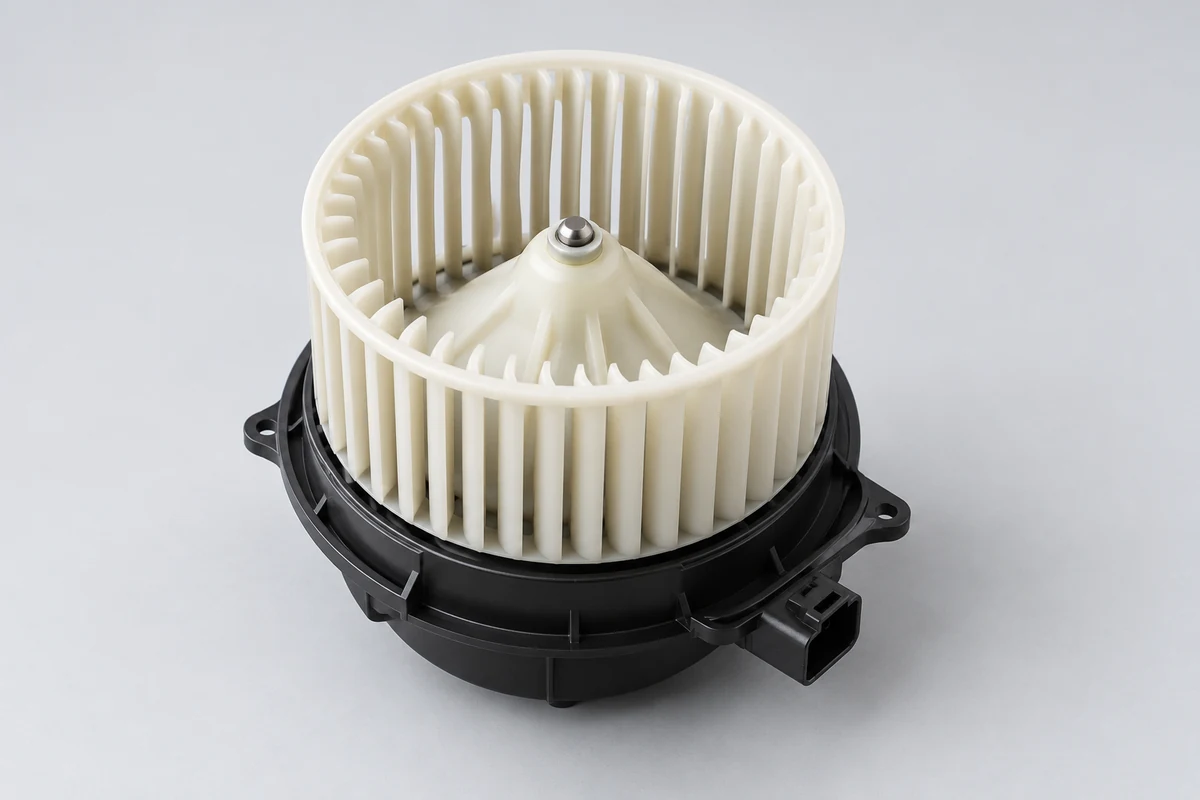
A cabin blower with a visibly cracked impeller blade should remain out of a powered check while its arrival condition is resolved. The motor’s intact label is useful for identity, but it does not answer the blade concern. Keep the impeller, surrounding housing and motor identification as separate evidence subjects.
This receiving review concerns an already specified, unused blower assembly. It does not establish balance, shaft condition or electrical performance, and it does not invite a finger-spin or energized demonstration to reassure the buyer.
Treat the impeller as part of the delivered object
DENSO describes cabin blower fans as combining an impeller with an electrical motor and distinguishes brush and brushless motor versions. That supports recording the actual assembly, rather than treating a motor label as the entire supplied product. It does not supply a balance limit or permission to interchange motor types. DENSO cabin-blower overview
Keep the approved assembly reference fixed. If the supplier’s label identifies only a motor, ask for the mapping to the supplied impeller and housing configuration required by the order. Do not assume that a familiar motor code establishes the identity of every attached part.
A product-family running video can show a type of assembly operating without depicting the unit in the buyer’s carton. Even a video of the delivered unit would need an authorized method, criteria and relevant timing before it could answer a technical question. It cannot simply replace a visible arrival-damage record.
Record accessible blades without turning the wheel
Use views available without rotating the impeller, disassembling the assembly or reaching between blades. Identify a visible blade concern relative to a fixed housing or mounting feature where that can be done clearly. If several blades are concealed, state the coverage limit rather than turning the wheel to claim a complete review.
Distinguish a clearly visible fracture from an uncertain line or a difference in blade appearance. Record the actual feature and source image. Do not flex a blade to confirm a crack, scrape a mark or remove a fragment for a clearer picture. An unresolved view can remain unresolved for a competent assessment.
If a loose fragment is visible in the packaging, document its location without assuming that it came from the identified impeller. The relationship may be plausible but still unproven. Avoid placing it against a blade to stage a reconstructed break.
Housing contact marks are a separate observation
A visible mark on the housing and a mark on the impeller may be relevant to the same concern, but their relationship needs evidence. Describe their locations without diagnosing rubbing during operation or a transport impact. Receiving may not know whether the unit was previously moved, powered or repacked.
Record accessible mounting and connector condition separately. A broken mounting feature cannot be cleared by an intact impeller, and a blade crack cannot be cleared by an undamaged connector shell. Keep these records attached to the assembly identity without converting their number into a quality score.
The absence of visible blade damage does not establish dynamic balance. Do not use a hand-spin impression, a universal shaft-play limit or sound from an improvised powered run as a receiving criterion. Those are different technical questions and require an appropriate authorized process.
An impeller-centered receiving worksheet
Use this original evidence aid to connect the actual blade concern to the complete assembly and its limitations.
| Record | Useful entry | What remains unresolved |
|---|---|---|
| Assembly identity | Approved reference and mapping from motor label | Whether attached components match the ordered assembly |
| Blade observation | Accessible location, fracture/line description and image | Hidden blades and any uncertain feature classification |
| Housing observation | Exact mark or apparent contact location | Cause and whether actual contact occurred |
| Connector/mounts | Separate visible condition | Electrical compatibility and mounting suitability |
| Packing relationship | Original restraints or loose-fragment position | Transport cause or fragment origin |
| Balance evidence | Applicable evidence required by the technical owner | Balance cannot be inferred from exterior appearance |
If a supplied report claims balance or another measured property, keep its unit or production-scope linkage and date visible for review. A report about another variant does not answer this assembly, and a pre-shipment report does not necessarily address a later arrival event.
Fictional counterexample: another unit’s running clip
A fictional blower B-3 has a visibly cracked blade in an accessible view, while its motor label is intact and agrees with the order. The supplier sends a running clip of another unit and asks the warehouse to power B-3 for comparison. All facts and identifiers are invented.
The buyer keeps B-3 out of operation and records the blade concern against the actual assembly. The clip is labelled as evidence about another unit. Its smooth-looking rotation does not answer B-3’s fracture, and the correct motor label does not remove the impeller from the supplied-object requirement.
Suppose the seller then proposes replacing only the wheel. That is a proposed technical and commercial scope, not a receiving instruction to dismantle the assembly. The responsible owner must decide what remedy and competent work, if any, are appropriate under the agreement. The receiver does not make an ad hoc repair to close the photograph record.
If a complete replacement is agreed instead, it receives its own identity and arrival review. B-3’s original condition remains documented, and neither assembly gains a balance certificate from this fictional example.
Finish with an exact-assembly response
Ask the supplier to identify the supplied impeller/motor configuration, address each visible concern and state what evidence supports its proposed outcome. Keep unknown balance and internal condition explicit. A commercial settlement, motor-type claim or generic demonstration is not technical release of the delivered blower.
Keep the buying request tied to the actual part
For category context, see Cooling parts; the supplier-check guide covers the earlier supplier review. Independent aftermarket or unbranded sourcing and authorized drawing-based proposals require their own product evidence. The manufacturer cited here is a documentary example, not an affiliation, branded-goods offer or endorsement of another supplier.
Start an Autoparts sourcing request with the exact received reference and the unresolved question. The form accepts an 8–1200-character description and up to five PNG, JPEG, WebP or GIF images, at most 10 MiB each and 20 MiB total. PDF, CAD and ZIP uploads are not supported. Arrange other technical files through a separately agreed, authorized exchange. Buying coordination and supplier negotiation do not establish an owned laboratory, an inspection service, engineering approval or a guaranteed remedy.
Frequently asked questions
Does the correct motor label prove the complete blower is acceptable?
It helps identify the motor, but the supplied impeller, housing and assembly mapping still matter. A visible blade concern needs its own response. Correct labelling does not establish balance, electrical performance or condition of attached components.
Can I rotate the impeller by hand to inspect every blade?
This receiving method uses accessible views without rotation or disassembly. Record concealed areas as unassessed and let the responsible owner define any further competent assessment. A hand-spin impression is not a balance or condition acceptance test.
Can a supplier’s running video resolve a cracked blade?
A video of another unit does not address the delivered unit’s crack. Any operational evidence also needs a relevant unit link, timing, method and criterion. Keep the identified damaged-looking assembly out of an improvised powered check.
Is replacing only the impeller an automatic receiving remedy?
No. It is a proposed scope requiring the appropriate technical and commercial decision. Do not dismantle or repair the delivered assembly on the assumption that this closes the issue. Record the proposal and obtain an authorized exact-assembly outcome.
Sources
Discuss a sourcing request related to this article.Check Blower Impeller Condition Before Applying Power