
Separate Oxygen Sensor Thread Coating from Tip Residue
Separate oxygen sensor thread coating from sensing-tip residue, preserve the original condition and request a product-specific explanation before cleaning.
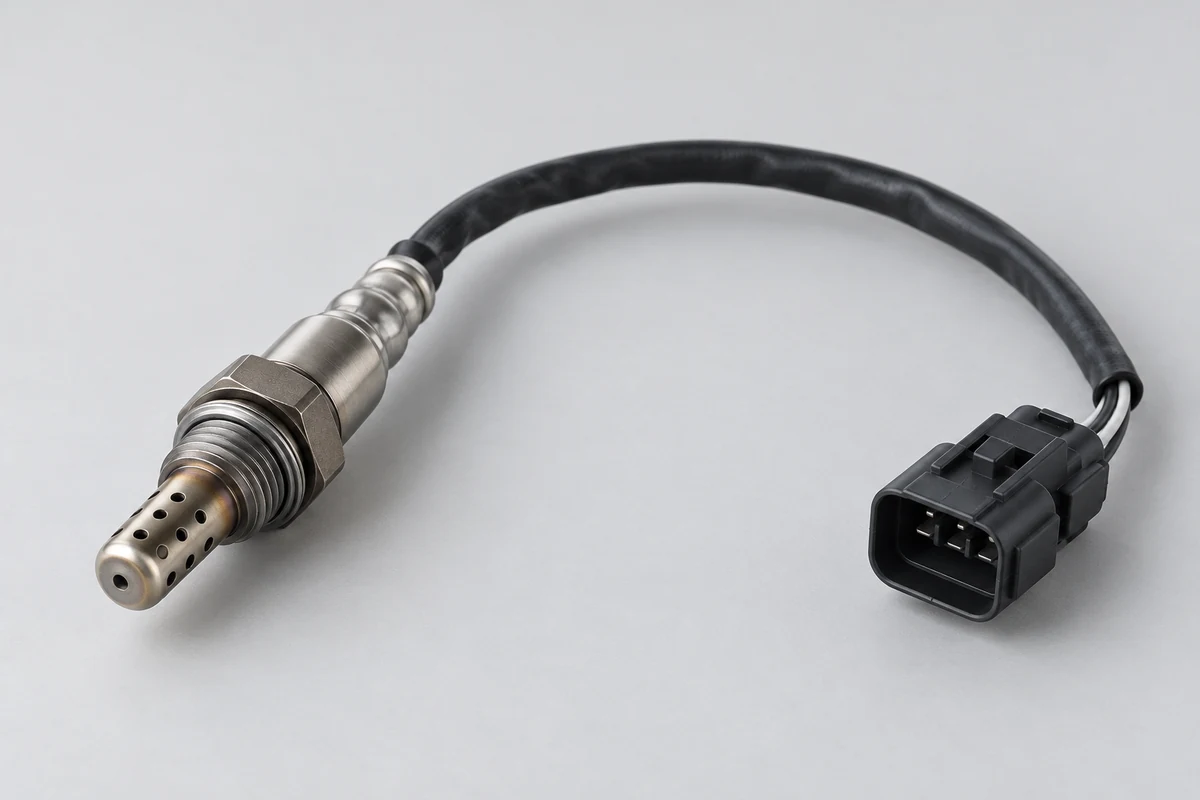
Residue on an unused oxygen sensor needs a location-specific record before anyone labels it harmless or cleans it away. A documented coating confined to the threads and an unidentified smear on the perforated sensing end are different observations. The buyer should keep them separate even when both look grey in a photograph.
This receiving decision concerns the supplied condition of an already identified sensor. It does not diagnose an engine, identify a substance by colour or establish electrical function. The first useful question is exactly where the material is and what product-specific document explains its presence.
A thread-coating explanation has a boundary
Niterra’s NTK oxygen-sensor article discusses contamination as a failure concern and, in its replacement guidance, distinguishes thread compound from the sensing portion that it must not contact. That is narrow service context for separating locations. It is not a method for identifying an unknown deposit on new stock or permission to apply, remove or redistribute a compound at receipt. NTK oxygen-sensor guidance
Ask for the supplied product’s coating declaration where the order or manufacturer’s information calls for one. It should identify the relevant part and the area to which the explanation applies. A seller’s “all sensors come like that” answer does not distinguish a thread treatment from a smear on the tip.
Do not treat absence of visible thread coating as an automatic defect either. The actual supplied specification controls. The purpose is to compare evidence with that specification, not impose one manufacturer’s service wording as a universal packaging or coating requirement.
Make a two-zone observation record
Record the thread area and the sensing end independently, using only accessible views that do not require touching or probing the sensor. If a supplied protector obscures a location, state that it is not visible. Do not remove protection solely to fill every box on a worksheet when the agreed handling scope does not permit it.
For a visible deposit, use plain language about position and extent. “Smear visible across the outer perforations in image O-04” is more useful than “anti-seize contamination” when the substance is unknown. A photo may show material without establishing its composition, origin or effect on the sensor.
Keep the supplied cap, sleeve or other protective packaging associated with the unit where present and safe to retain. Its condition can explain what was visible on opening, but a missing protector alone does not prove sensor failure. Likewise, an intact sleeve cannot explain a deposit that is visibly on the sensing end.
Preserve the initial observation time and any disclosed prior handling. If a warehouse already wiped a unit, do not present a later clean photograph as its original arrival state. Record that the condition changed and identify the missing evidence rather than trying to reconstruct a pristine history.
Do not let cleaning become acceptance
A proposed wipe or solvent treatment changes the evidence and introduces a different technical question. The supplier should first address whether the delivered unit matches the agreed supplied condition and what remedy or qualified disposition is appropriate. A clean-looking tip afterward would not establish restored sensing performance.
Do not use heater-resistance checks, energizing or an installation trial to close this observation. Those activities do not belong in an ordinary receiving clarification. If the responsible technical reviewer needs further assessment, it requires an agreed product-specific scope, competent provider and evidence output.
A residue-location worksheet
This original evidence aid deliberately separates what can be seen from what the supplier has substantiated.
| Field | What to enter | What the entry cannot prove |
|---|---|---|
| Sensor identity | Ordered code, actual marking and unit/package reference | Correct application from appearance alone |
| Thread zone | Coating location visible in the original view | Chemical identity of an unknown material |
| Sensing-end zone | Deposit, unclear feature or not visible | Whether sensor characteristics are acceptable |
| Supplied protection | Cap/sleeve state and linked image | Complete exposure or handling history |
| Coating explanation | Exact product document and covered location | Approval of material outside that location |
| Pending outcome | Unit-specific question and responsible reviewer | Automatic entitlement to a replacement |
If the supplier supplies an annotated image, retain the original beside it and check that it depicts the delivered unit rather than a catalogue example. A correct explanation of threads is useful but still does not answer a separately documented tip concern.
Fictional counterexample: the same colour is not the same evidence
Imagine two fictional sensors, O-A and O-B. O-A has a thread-only coating consistent with the supplied product declaration. O-B has an unidentified smear on its perforated sensing end. The seller sends the same thread-compound explanation for both and suggests wiping O-B. These sensors and events are invented.
The buyer can record that O-A’s visible thread coating has a relevant documentary explanation, while leaving every other acceptance requirement intact. O-B remains held for an explanation and disposition of the sensing-end condition. Similar colour does not extend O-A’s document to O-B’s location, and no cleaning is undertaken to make their photographs match.
If the seller offers a replacement for O-B, the buyer considers the exact remedy terms and requested handling arrangements. The replacement has its own receipt record; the original smear remains part of the original evidence. If the seller instead provides only a broad warranty statement, the location-specific question remains open.
Close the explanation at the right scope
A satisfactory record states which substance or condition has been identified, by whom, on which unit and with what evidence limits. Where identification remains uncertain, preserve that uncertainty for the technical decision. Neither a thread-coating declaration nor a tidy exterior proves calibration, fit or safe operation.
Keep the buying request tied to the actual part
For category context, see Engine parts; the supplier-check guide covers the earlier supplier review. Independent aftermarket or unbranded sourcing and authorized drawing-based proposals require their own product evidence. The manufacturer cited here is a documentary example, not an affiliation, branded-goods offer or endorsement of another supplier.
Start an Autoparts sourcing request with the exact received reference and the unresolved question. The form accepts an 8–1200-character description and up to five PNG, JPEG, WebP or GIF images, at most 10 MiB each and 20 MiB total. PDF, CAD and ZIP uploads are not supported. Arrange other technical files through a separately agreed, authorized exchange. Buying coordination and supplier negotiation do not establish an owned laboratory, an inspection service, engineering approval or a guaranteed remedy.
Frequently asked questions
Can I assume a grey smear is anti-seize?
No. Colour and texture in an image do not establish the material. Record its exact location and request an explanation tied to the supplied sensor. A thread-compound declaration does not automatically cover a smear on the sensing end.
Should all new oxygen sensors arrive with visibly coated threads?
Use the actual product specification and agreed supply record. This article does not prescribe a universal coating requirement. An absent coating or a different appearance is a clarification question where the applicable documents do not resolve it.
Would a clean tip after wiping settle the issue?
No. Wiping changes the original evidence and a clean appearance cannot establish sensing performance. Preserve the as-received record and ask for the appropriate unit-specific disposition instead of treating cleaning as an acceptance step.
Does a missing protective cap prove the sensor is contaminated?
It establishes a packaging observation only when that cap was expected for the supplied product. Record what is visible and what history is unknown. Contamination, electrical condition and any remedy require their own evidence and decision.
Sources
Discuss a sourcing request related to this article.Separate Oxygen Sensor Thread Coating from Tip Residue