
Molded Coolant Hose RFQ: Branches and End Fittings
Map the required molded hose assembly, branches, end fittings, sleeve and clamps so a bulk-tube quote cannot hide missing assembly scope.
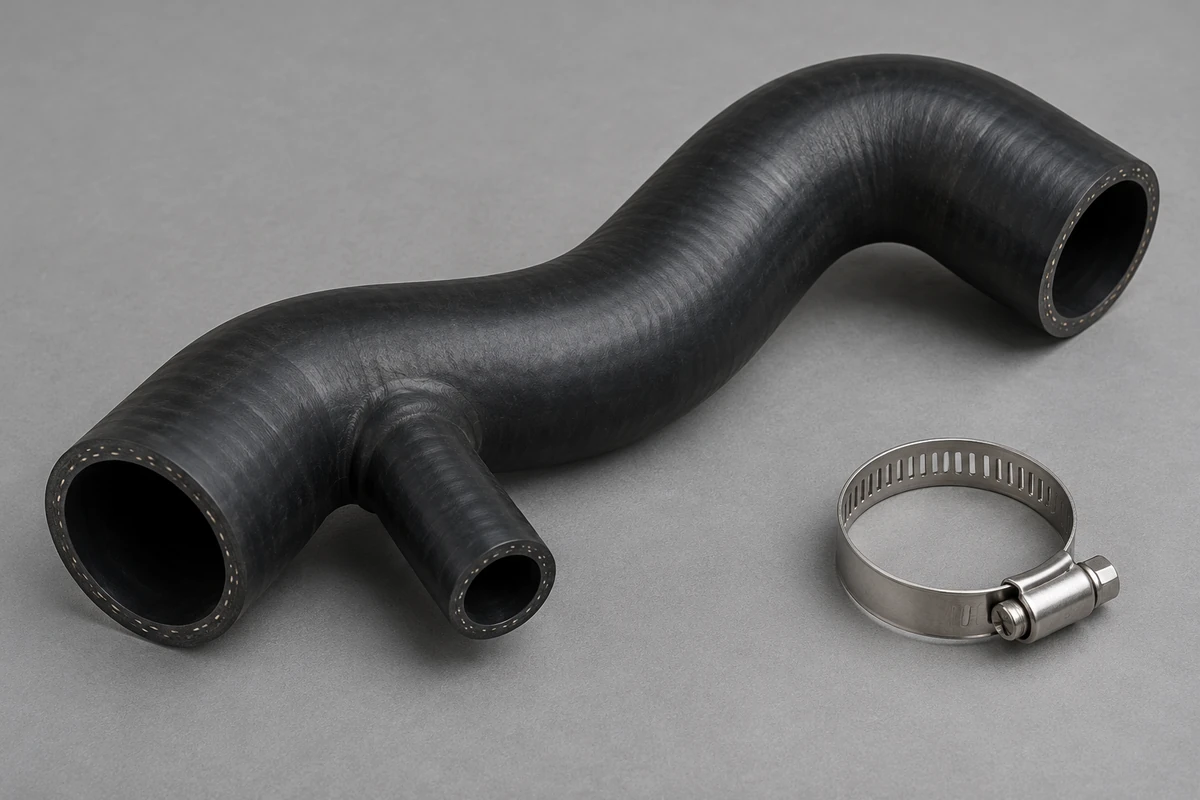
A molded branched coolant hose assembly is not the same supplied object as straight tube priced by length. Start the RFQ with the authorized assembly drawing or application record, then identify the branches and each required end fitting. A material label cannot fill in a missing end map.
The purchasing decision is whether the supplier’s proposal covers the required formed assembly and its defined contents. It is not permission to change hose routing, assemble an improvised replacement or transfer a catalogue pressure or temperature rating to another product.
Read supported fields without reconstructing missing geometry
Dorman’s 626-862 specifications describe a formed, molded EPDM assembly with a junction, an attached protective sleeve and one quick-connect fitting. However, the page’s title and descriptive text are inconsistent, and its listed end numbers do not form a complete consecutive end map. Preserve those limitations: the page does not justify inventing a junction material or a full port arrangement. Dorman 626-862 specifications
The example supports a scope question, not a manufacturing definition. Do not copy disconnected diameter fields into an imagined branch drawing. Nor should a description of one product establish the rating, connector completeness or clamp scope of a supplier’s different hose.
For the actual request, obtain the controlled drawing or application-specific information that identifies all required ends and branches. If that record is incomplete, return the gap to the responsible owner rather than choosing a plausible layout from the listing photograph.
Build the end map from the authorized assembly
Give each end the identifier used in the actual controlled drawing. Record its required interface and fitting reference, and keep the junction and branch relationships tied to the same drawing. The end map should describe the supplied assembly, not instruct someone how to route it through a vehicle.
Ask the supplier to answer each end individually. A statement that one quick connector is included does not identify which end it serves unless the drawing or product-specific reply makes that connection. A bare hose end and an end supplied with a fitting must remain different scope states.
If a seller offers a different branch arrangement, record it as a changed proposal. Do not treat extra tube length as compensation for the wrong layout. The buyer should not authorize cutting, joining or rerouting to turn a stock tube into a presumed equivalent assembly.
Separate protective and attachment contents
List the required sleeve, clamps, connectors and junction scope within the authorized purchase. Ask which are attached, supplied separately or excluded. A component mentioned in a family description is not automatically included in every priced variant.
Keep material and required evidence separate from the contents list. “EPDM” identifies a broad material description, but it cannot establish all environmental or performance requirements for the offered assembly. Likewise, a clear connector list does not substantiate the hose’s required technical performance.
Where drawing-based customization is proposed, request the actual offered material, geometry and assembly contents with explicit deviations. Do not assume that the supplier can produce a molded shape or provide an accepted connector merely because it can quote bulk hose.
A branch-and-end worksheet
| Record | Buyer information | Supplier answer |
|---|---|---|
| Assembly identity | Authorized application/drawing and revision | Exact offered assembly or changed proposal |
| Branch layout | Controlled drawing references | Corresponding layout and stated differences |
| End map | Every authorized end identifier | Offered interface/fitting for each end |
| Junction | Defined component and scope | Actual supplied junction description |
| Quick connectors | Required end assignments | Included, separate or excluded by end |
| Sleeve and clamps | Required identities and supplied state | Attached, loose or excluded items |
| Material/evidence | Authorized requirement and reviewer | Actual proposal and unresolved evidence |
Do not create an end count by guessing what an absent number means. The worksheet is complete only when it points to the actual controlled assembly definition and preserves every unresolved end or contents question.
Fictional comparison: bulk tube versus an incomplete assembly
A fictional buyer requests a molded branch assembly under an authorized drawing. Offer A is straight tube by length. Offer B supplies a molded assembly but leaves one required end unidentified and gives no clear clamp-scope answer. Neither proposal is a real supplier quote or an accepted component.
A does not answer the assembly request. The buyer asks whether the supplier can quote the authorized molded object; if not, it stays outside this comparison. Do not turn A into a matching option by inventing joining operations, routing changes or a fitting allowance.
B is closer in supplied-object description but remains incomplete. Send the missing end’s drawing identifier and ask for its interface and fitting scope. Ask separately about the required clamps so an answer about the protective sleeve does not accidentally close that row.
If B replies only “same EPDM material,” the end question remains unanswered. If it proposes a different fitting, retain the proposal and refer it for responsible acceptance. A material family and a photograph cannot settle an interface difference.
Request price after the assembly is legible
Ask for actual same-assembly pricing and quantity terms, with separate alternatives for any declared changes. Preserve the offered drawing/revision and itemized contents alongside the quotation. A custom proposal can be useful without an invented saving, delivery date or claim of an already qualified factory.
The final buying record should identify each required branch and end, the supplied fittings, sleeve and clamps, and the technical questions still open. It enables a meaningful comparison while keeping application approval and required performance evidence outside the reach of a generic hose listing.
Prepare the sourcing request
For the broader product group, see Cooling parts. If the application is not established, start with the OE and application identification guide before asking for a substitute.
Use the Autoparts sourcing request to describe the required item and the particular question left open above. The form accepts a description of 8–1200 characters and up to five PNG, JPEG, WebP or GIF images, limited to 10 MiB each and 20 MiB total. It does not accept CAD, PDF or ZIP attachments. Authorized drawing images can start a discussion; arrange other technical files separately through an actually agreed, authorized exchange.
Keep requests for independent aftermarket or unbranded alternatives tied to the authorized application or drawing. Supplier negotiation and a drawing-based proposal do not establish engineering acceptance, actual manufacturing capability or guaranteed savings. Named catalogue products in this article are documentary examples, not branded-goods offers or approvals of an unknown alternative.
Frequently asked questions
Can bulk coolant hose be compared with a molded branch assembly?
It is a different supplied object. Ask for the authorized molded assembly and its required branches and fittings. Do not assume that extra length, joining work or additional loose fittings will create an accepted equivalent.
What should I do if catalogue end numbering is incomplete?
Keep the missing mapping explicit and request the controlled assembly drawing or authoritative clarification. Do not infer the number, order or function of ends from gaps in a web table or from a product photograph.
Does one included quick connector identify the whole fitting scope?
No. The response should identify the end it belongs to and the required interface, plus the scope at every other end. Ask separately about junctions, clamps and sleeves rather than treating one connector count as a complete contents list.
Does an EPDM label establish the offered hose’s rating?
No. The actual material and assembly need evidence appropriate to the authorized requirement. Do not transfer pressure, temperature or durability claims from another catalogue product. Keep the product-specific evidence request separate from geometry and contents clarification.
Sources
Discuss a sourcing request related to this article.Molded Coolant Hose RFQ: Branches and End Fittings