
Control Arm RFQ: Bare Arm or Equipped Assembly?
Compare control-arm quotes by application, installed ball joint, included bushings and hardware while keeping structural acceptance separate.
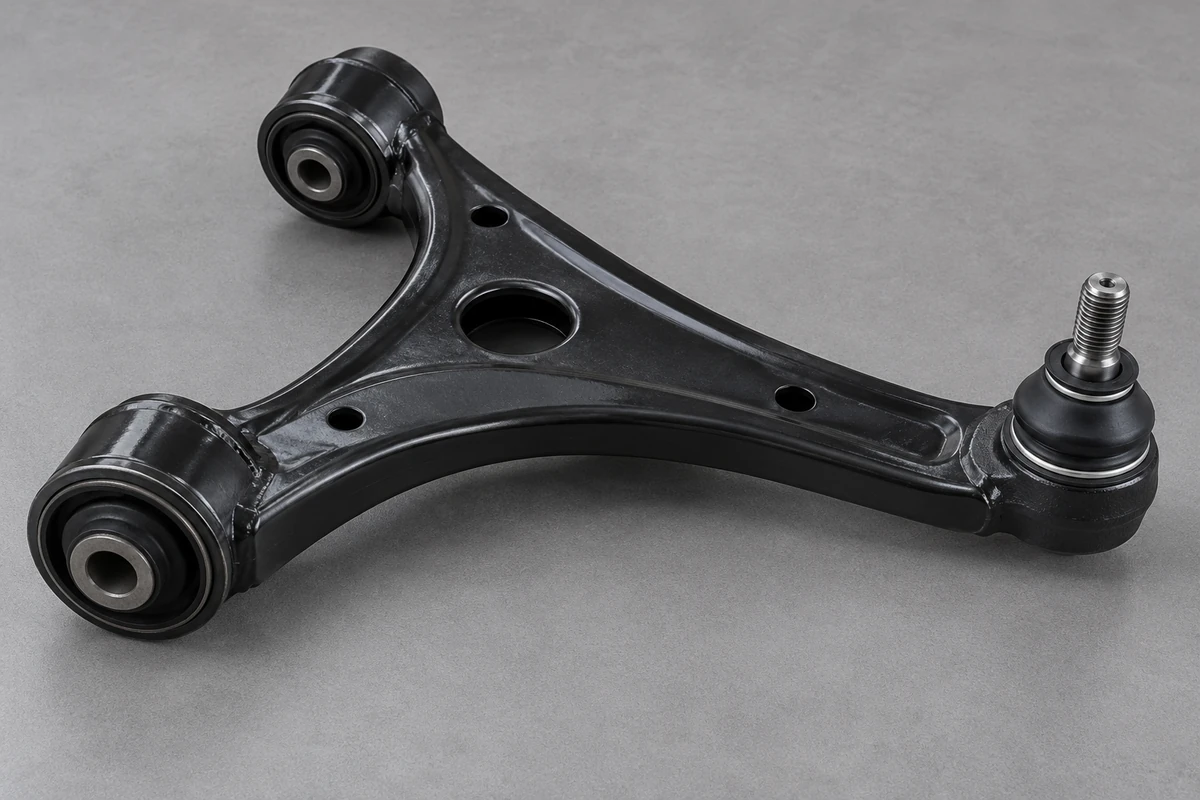
A bare control arm and an arm supplied with an installed ball joint and bushings are different delivered objects. Before comparing an affordable alternative, state which object the approved request requires. A shared outline or material label cannot make an incomplete assembly price comparable or establish the safety of a replacement.
The exact application, position and fixed or adjustable requirement belong at the start of the RFQ. Purchasing should preserve those authorized requirements, not choose a changed suspension design to match a supplier’s stock.
Read “included” and “installed” separately
Dorman’s 524-840 specifications describe a non-adjustable stamped-steel arm with a ball joint both included and installed, bushings included, and mounting hardware excluded. This illustrates a useful contents distinction. It is not evidence that another stamped-steel arm has equivalent strength, fatigue behavior or geometry. Dorman 524-840 assembly scope
For the actual purchase, ask whether the ball joint is supplied as part of the offered assembly or as a separate loose item. The words “with ball joint” may not settle its supplied state. If the approved requirement calls for an equipped assembly, identify that explicitly rather than assuming the buyer will arrange additional work.
List bushings independently from the ball joint. A supplier may include one component group without the other. Do not infer bushing inclusion from a photo, the word complete or the fact that another model in the same catalogue includes them.
Define the exact position before comparing assembly scope
Keep the authorized side, axle and position terminology attached to the part reference. Do not replace a specific application record with “front arm” when the requirement is more precise. Where supplier evidence names a different variant or position, keep that mismatch open even if the component list appears complete.
Record fixed versus adjustable scope from the authorized requirement. A seller’s adjustable alternative is not simply an enhanced version of a fixed arm, and a fixed part is not automatically an acceptable economy replacement for an adjustable design. Such proposals need separate authorized technical consideration.
If a drawing-based proposal is invited, it must identify the actual assembly boundary and required acceptance evidence. A drawing establishes proposed geometry and requirements, not an existing factory’s capability or completed product validation. Avoid promising that a lower-cost process, different material or similar appearance preserves structural performance.
A supplied-state worksheet
| Scope item | Required answer | What not to infer |
|---|---|---|
| Application and position | Exact authorized reference | Fit from outline or a broad vehicle name |
| Arm configuration | Required fixed/adjustable scope | One design can replace the other |
| Ball joint | Included and supplied state | Included necessarily means installed |
| Bushings | Required items and included state | Ball-joint inclusion covers bushings too |
| Mounting hardware | Named included/excluded items | A complete assembly contains every fastener |
| Validation | Required product-specific evidence and owner | Material or contents prove strength |
The worksheet deliberately keeps contents and validation in separate rows. A complete contents answer allows a fairer commercial comparison, but it is not a technical pass. Conversely, a claim about testing does not tell the buyer whether required bushings are actually in the quoted package.
Fictional comparison: a bare arm is a changed object
A fictional request calls for an equipped arm for an established position, with the required joint installed and the specified bushings included. Offer A is a bare arm. Offer B lists a joint and bushings but does not say whether the joint is installed. Neither is a real product recommendation or supplier offer.
A fails the delivered-object basis. The buyer asks for an equipped-assembly quote if the supplier can provide one. Do not invent assembly labor or assume that separately sourced parts can be combined acceptably to make A look complete. That would introduce a different scope requiring its own authorization and evidence.
B requires a narrower clarification: identify the actual supplied state of the joint and the included bushings. Even if B confirms the required state, application and structural acceptance remain subject to the necessary product-specific evidence. A detailed contents list cannot stand in for that evidence.
Suppose a later reply offers a lower-cost adjustable arm instead of the requested fixed configuration. Preserve it as a changed proposal, not a revised matching price. A purchasing comparison should make the design difference visible before any price advantage is discussed.
Negotiate the requested assembly, then keep the acceptance gate
Request actual prices for the same supplied state and hardware boundary. Any optional items should have distinct scope so their presence in a sales message does not overwrite their exclusion from the price. Ask for a consolidated quotation once the assembly contents are clear.
Do not use a percentage saving, a broad factory claim or a visual comparison as an acceptance criterion. An unbranded or drawing-based candidate needs evidence appropriate to the actual suspension application and review by the responsible competent person. If the evidence cannot be established, retain the candidate as unapproved regardless of the price.
The useful outcome is a quotation that names the exact equipped or bare object, its joint and bushing state, excluded hardware and remaining technical questions. It does not authorize pressing, adjustment, installation, load testing or a road trial.
Prepare the sourcing request
For the broader product group, see Suspension parts. If the application is not established, start with the OE and application identification guide before asking for a substitute.
Use the Autoparts sourcing request to describe the required item and the particular question left open above. The form accepts a description of 8–1200 characters and up to five PNG, JPEG, WebP or GIF images, limited to 10 MiB each and 20 MiB total. It does not accept CAD, PDF or ZIP attachments. Authorized drawing images can start a discussion; arrange other technical files separately through an actually agreed, authorized exchange.
Keep requests for independent aftermarket or unbranded alternatives tied to the authorized application or drawing. Supplier negotiation and a drawing-based proposal do not establish engineering acceptance, actual manufacturing capability or guaranteed savings. Named catalogue products in this article are documentary examples, not branded-goods offers or approvals of an unknown alternative.
Frequently asked questions
Does with ball joint mean the joint is already installed?
Not necessarily. Ask for the supplied state of the exact offered assembly. If the approved request requires an installed joint, record that explicitly and do not treat a loose included joint as the same commercial scope.
Can a bare control arm quote be compared with an equipped assembly?
Only after the different supplied objects are made explicit. Do not invent costs or assume that loose parts and labor recreate an accepted assembly. Request the required equipped scope or treat the bare-arm proposal as a different request requiring authorization.
Do matching steel material and dimensions prove an alternative is safe?
No. They do not establish fatigue behavior, structural performance or application suitability. Keep required product-specific validation and competent technical acceptance separate from the contents comparison and any commercial negotiation.
Can an adjustable arm replace the requested fixed arm to save money?
That is a design change, not an ordinary price concession. Preserve the authorized fixed or adjustable requirement and record the other configuration as a separate proposal. The RFQ worksheet does not authorize a suspension modification or establish interchangeability.
Sources
Discuss a sourcing request related to this article.Control Arm RFQ: Bare Arm or Equipped Assembly?